
 Image 1 of 1
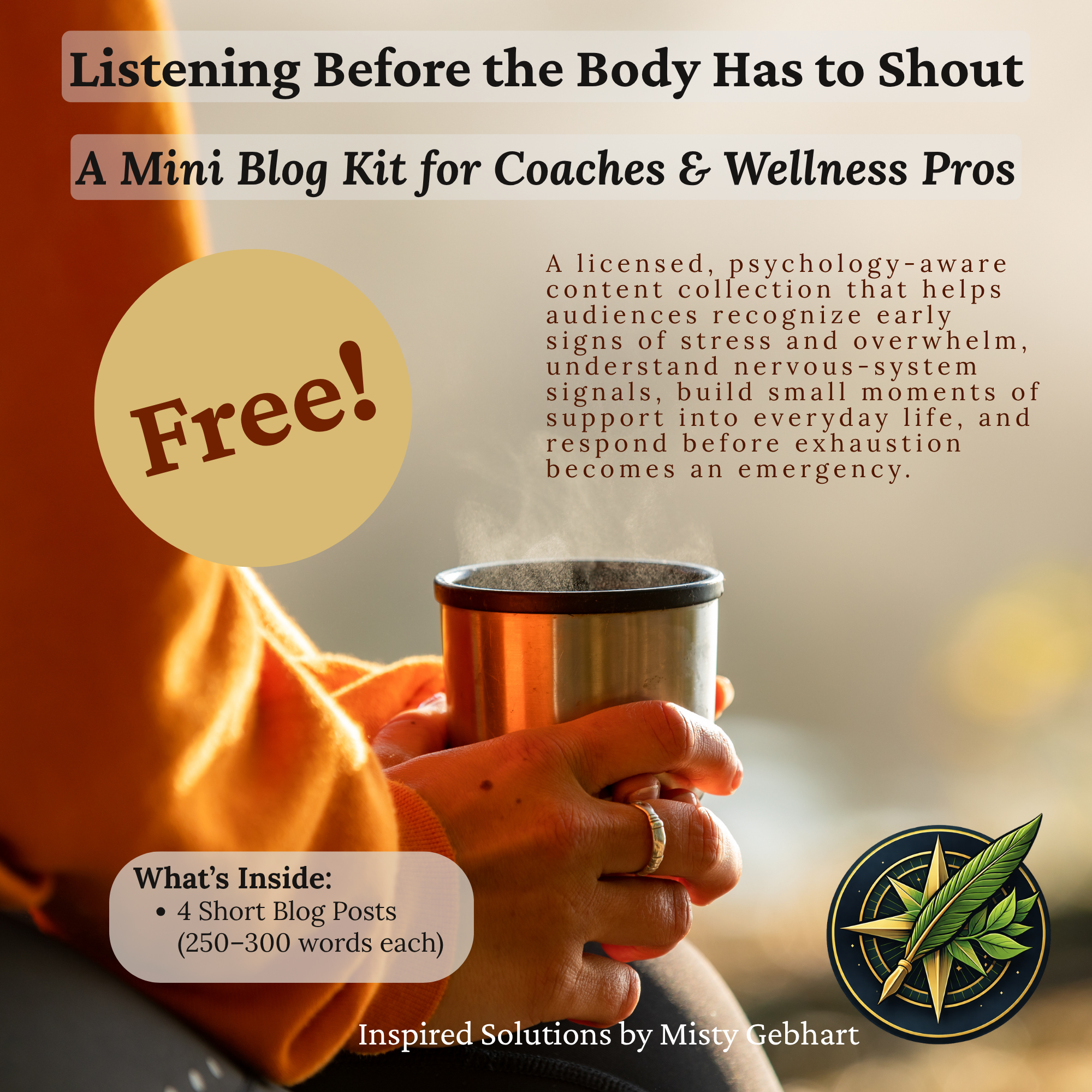
Listening Before the Body Has to Shout - Mini Blog Set
Give your audience simple ways to notice when everyday stress isn't actually over yet.
The email feels urgent.
The difficult conversation ends, but your shoulders stay tense.
A few peaceful minutes don't seem like enough to matter.
And sometimes stress has been present for so long that it doesn't even register as stress anymore.
It just feels normal.
Listening Before the Body Has to Shout brings attention to those quieter moments.
This free four-part Mini Blog Set gives you ready-to-share, human-centered wellness education that helps your audience recognize unnecessary urgency, make room for small experiences of calm, question stress patterns that have become familiar, and give the body a clearer signal when a stressful moment has ended.
Four short wellness articles. Ready to share. Completely free.
The Listening Before the Body Has to Shout Mini Blog Set is a collection of four short, ready-to-share wellness articles for businesses, employers, wellness professionals, and organizations that want practical stress-support content without adding another complicated wellbeing practice to people's lives.
Each article explores one small way stress can remain active in ordinary life — and gives readers a different way to notice or respond.
Publish them throughout the month or use them individually whenever the topic fits your audience.
What's inside
4 short, ready-to-share wellness articles
One cohesive wellness theme
Practical, human-centered education
Licensed use with your own audience
Permission to publish across multiple approved channels
Indefinite use when the license terms are followed
$0 cost
Use them on your website or blog, in email newsletters, employee wellness communications, internal employee platforms, social media, or communications to your patients, clients, customers, or members.
Free — $0
No subscription. No trial period. No future payment required to keep using content you've legitimately obtained.
Download the set, follow the included Free Content License, and share the articles with your own audience.
As long as the license terms are followed, content legitimately obtained through the Free Content program may continue to be used indefinitely.
The Mini Blog Series
Not Everything Is Actually Urgent
Explores how easily urgency can become the default setting of an ordinary day.
The notification appears.
The email arrives.
Someone asks a question.
A new task lands.
And before we've consciously decided how quickly it needs our attention, the body may already be responding as though something important is happening right now.
But not everything that asks for attention requires an immediate response.
This article invites readers to notice the difference between something being important and something being urgent — and to create a little more space before automatically reacting to every demand.
Sometimes the most supportive response is simply recognizing:
This matters. And it can still wait ten minutes.
That tiny distinction can give the body fewer reasons to spend the entire day responding as though everything is an emergency.
Calm Doesn't Have to Last All Day to Count
Challenges the idea that a brief moment of calm is somehow meaningless because stress eventually returns.
Maybe you step outside for five minutes and feel better — then walk back into a busy afternoon.
Maybe one quiet cup of coffee helps you settle before the next responsibility begins.
Maybe you take three slow breaths, relax your shoulders, listen to one song, or sit somewhere peaceful for a few minutes.
Then life starts moving again.
That doesn't erase the calmer moment.
This article reminds readers that support doesn't have to transform the entire day to be valuable.
A few minutes of ease still gave the body a different experience.
A brief pause still interrupted constant activation.
Calm doesn't have to become permanent before it counts.
Sometimes a few good minutes really are a few good minutes — and they're allowed to matter.
Familiar Doesn't Always Mean Fine
Looks at one reason ongoing stress can become surprisingly difficult to recognize:
We get used to it.
The clenched jaw.
The shoulders that rarely relax.
Checking email immediately after waking.
Always feeling slightly behind.
Difficulty sitting still without reaching for something else to do.
Thinking about work long after the workday ends.
When something happens often enough, it can stop feeling unusual.
That doesn't necessarily mean it's working well for us.
This article encourages readers to become curious about the difference between normal and familiar.
Something can be familiar because we've adapted to it, accommodated it, or lived with it for a long time.
And sometimes noticing that distinction is enough to begin asking a useful question:
Does this actually feel okay — or have I simply gotten used to feeling this way?
Your Body Needs an End to the Stressful Moment
Explores what can happen after the stressful event is technically finished.
The meeting ends.
The difficult phone call is over.
The deadline is met.
The uncomfortable conversation concludes.
Externally, the moment has ended.
Internally, the body may still be holding onto it.
This article brings attention to the value of creating a small transition after stressful experiences rather than immediately launching into whatever comes next.
That transition doesn't need to be elaborate.
Stand up.
Walk to another room.
Stretch.
Wash your hands.
Step outside.
Take a slower breath.
Get a drink.
Put on a familiar song.
The point isn't to perform the perfect calming technique.
It's simply to give the body a clearer cue:
That moment is over now.
Sometimes the nervous system needs help recognizing an ending that the calendar already knows happened.
Why offer Inspired Chapter content to your audience?
Stress education can become another list of things people are supposed to do correctly.
Meditate more. Relax better. Create the perfect morning routine. Become calmer.
These Mini Blogs take a smaller approach.
They help readers notice what may already be happening during an ordinary workday or ordinary life — and recognize small opportunities to reduce unnecessary activation without turning nervous-system support into another project.
They're short enough to be accessible and practical enough to create a meaningful shift in perspective.
And because they're already written and licensed for your direct audience, you can focus on sharing the conversation instead of creating it.
Publish it inside your own branded channels
Your website can still look like your website. Your newsletter can still look like your newsletter. Your social channels can still look like your business.
Ordinary visual formatting is permitted, and the Mini Blogs can appear within your normally branded environment.
The articles themselves remain Inspired Chapter content and must be published intact, including the supplied attribution and Inspired Chapter call to action.
Each article includes:
Written by Misty Gebhart | Inspired Chapter
More practical, human-centered wellness education from Inspired Chapter.
Those elements stay with the article when you publish it.
Want to go deeper?
The Mini Blog Set gives your audience an approachable introduction to the Listening Before the Body Has to Shout conversation.
When you want more substantial content around the same theme, Inspired Chapter offers two licensed options:
The Themed Blog Set — $150
Four full-length wellness articles exploring early signs of overwhelm, the value of small supportive moments, helping the body experience safety, and making rest part of the rhythm before exhaustion takes over.
The Month-in-a-Box — $249
The complete Listening Before the Body Has to Shout content system, including the long-form anchor article, four supporting blogs, a 28-day content planner, light assets, and The Body Is Speaking: Creating Your Personal Early Warning Signal Map practical guide.
Start with what you need. Go deeper when it makes sense.
Who this is for
Wellness businesses that want approachable stress-awareness content for their audiences
HR and People Operations teams looking for practical employee wellbeing education
Healthcare and wellness professionals who want human-centered content around everyday stress and recovery
Small businesses without dedicated wellness content teams
Organizations that want to encourage earlier support without waiting until the conversation becomes burnout
Who this is not for
Anyone looking for white-label content
Anyone looking for content they can rewrite, repurpose, excerpt, or claim as their own
Businesses looking for content to resell or redistribute to other organizations
Anyone looking for clinical, therapeutic, diagnostic, medical, legal, or individualized professional advice
A quick note about the Free Content License
Free doesn't mean public domain.
Your download gives you permission to publish and share these Mini Blogs with your own audience. The content must remain intact, including the supplied Inspired Chapter attribution and CTA, and cannot be rewritten, adapted, excerpted, resold, sublicensed, or transferred to another business or organization.
Each business or organization that wants to use the content must obtain its own copy directly from Inspired Chapter and agree to the Free Content License.
All content remains the intellectual property of Inspired Chapter and/or Misty Gebhart and is provided under license. © 2026 Inspired Chapter. All Rights Reserved.
Give your audience simple ways to notice when everyday stress isn't actually over yet.
The email feels urgent.
The difficult conversation ends, but your shoulders stay tense.
A few peaceful minutes don't seem like enough to matter.
And sometimes stress has been present for so long that it doesn't even register as stress anymore.
It just feels normal.
Listening Before the Body Has to Shout brings attention to those quieter moments.
This free four-part Mini Blog Set gives you ready-to-share, human-centered wellness education that helps your audience recognize unnecessary urgency, make room for small experiences of calm, question stress patterns that have become familiar, and give the body a clearer signal when a stressful moment has ended.
Four short wellness articles. Ready to share. Completely free.
The Listening Before the Body Has to Shout Mini Blog Set is a collection of four short, ready-to-share wellness articles for businesses, employers, wellness professionals, and organizations that want practical stress-support content without adding another complicated wellbeing practice to people's lives.
Each article explores one small way stress can remain active in ordinary life — and gives readers a different way to notice or respond.
Publish them throughout the month or use them individually whenever the topic fits your audience.
What's inside
4 short, ready-to-share wellness articles
One cohesive wellness theme
Practical, human-centered education
Licensed use with your own audience
Permission to publish across multiple approved channels
Indefinite use when the license terms are followed
$0 cost
Use them on your website or blog, in email newsletters, employee wellness communications, internal employee platforms, social media, or communications to your patients, clients, customers, or members.
Free — $0
No subscription. No trial period. No future payment required to keep using content you've legitimately obtained.
Download the set, follow the included Free Content License, and share the articles with your own audience.
As long as the license terms are followed, content legitimately obtained through the Free Content program may continue to be used indefinitely.
The Mini Blog Series
Not Everything Is Actually Urgent
Explores how easily urgency can become the default setting of an ordinary day.
The notification appears.
The email arrives.
Someone asks a question.
A new task lands.
And before we've consciously decided how quickly it needs our attention, the body may already be responding as though something important is happening right now.
But not everything that asks for attention requires an immediate response.
This article invites readers to notice the difference between something being important and something being urgent — and to create a little more space before automatically reacting to every demand.
Sometimes the most supportive response is simply recognizing:
This matters. And it can still wait ten minutes.
That tiny distinction can give the body fewer reasons to spend the entire day responding as though everything is an emergency.
Calm Doesn't Have to Last All Day to Count
Challenges the idea that a brief moment of calm is somehow meaningless because stress eventually returns.
Maybe you step outside for five minutes and feel better — then walk back into a busy afternoon.
Maybe one quiet cup of coffee helps you settle before the next responsibility begins.
Maybe you take three slow breaths, relax your shoulders, listen to one song, or sit somewhere peaceful for a few minutes.
Then life starts moving again.
That doesn't erase the calmer moment.
This article reminds readers that support doesn't have to transform the entire day to be valuable.
A few minutes of ease still gave the body a different experience.
A brief pause still interrupted constant activation.
Calm doesn't have to become permanent before it counts.
Sometimes a few good minutes really are a few good minutes — and they're allowed to matter.
Familiar Doesn't Always Mean Fine
Looks at one reason ongoing stress can become surprisingly difficult to recognize:
We get used to it.
The clenched jaw.
The shoulders that rarely relax.
Checking email immediately after waking.
Always feeling slightly behind.
Difficulty sitting still without reaching for something else to do.
Thinking about work long after the workday ends.
When something happens often enough, it can stop feeling unusual.
That doesn't necessarily mean it's working well for us.
This article encourages readers to become curious about the difference between normal and familiar.
Something can be familiar because we've adapted to it, accommodated it, or lived with it for a long time.
And sometimes noticing that distinction is enough to begin asking a useful question:
Does this actually feel okay — or have I simply gotten used to feeling this way?
Your Body Needs an End to the Stressful Moment
Explores what can happen after the stressful event is technically finished.
The meeting ends.
The difficult phone call is over.
The deadline is met.
The uncomfortable conversation concludes.
Externally, the moment has ended.
Internally, the body may still be holding onto it.
This article brings attention to the value of creating a small transition after stressful experiences rather than immediately launching into whatever comes next.
That transition doesn't need to be elaborate.
Stand up.
Walk to another room.
Stretch.
Wash your hands.
Step outside.
Take a slower breath.
Get a drink.
Put on a familiar song.
The point isn't to perform the perfect calming technique.
It's simply to give the body a clearer cue:
That moment is over now.
Sometimes the nervous system needs help recognizing an ending that the calendar already knows happened.
Why offer Inspired Chapter content to your audience?
Stress education can become another list of things people are supposed to do correctly.
Meditate more. Relax better. Create the perfect morning routine. Become calmer.
These Mini Blogs take a smaller approach.
They help readers notice what may already be happening during an ordinary workday or ordinary life — and recognize small opportunities to reduce unnecessary activation without turning nervous-system support into another project.
They're short enough to be accessible and practical enough to create a meaningful shift in perspective.
And because they're already written and licensed for your direct audience, you can focus on sharing the conversation instead of creating it.
Publish it inside your own branded channels
Your website can still look like your website. Your newsletter can still look like your newsletter. Your social channels can still look like your business.
Ordinary visual formatting is permitted, and the Mini Blogs can appear within your normally branded environment.
The articles themselves remain Inspired Chapter content and must be published intact, including the supplied attribution and Inspired Chapter call to action.
Each article includes:
Written by Misty Gebhart | Inspired Chapter
More practical, human-centered wellness education from Inspired Chapter.
Those elements stay with the article when you publish it.
Want to go deeper?
The Mini Blog Set gives your audience an approachable introduction to the Listening Before the Body Has to Shout conversation.
When you want more substantial content around the same theme, Inspired Chapter offers two licensed options:
The Themed Blog Set — $150
Four full-length wellness articles exploring early signs of overwhelm, the value of small supportive moments, helping the body experience safety, and making rest part of the rhythm before exhaustion takes over.
The Month-in-a-Box — $249
The complete Listening Before the Body Has to Shout content system, including the long-form anchor article, four supporting blogs, a 28-day content planner, light assets, and The Body Is Speaking: Creating Your Personal Early Warning Signal Map practical guide.
Start with what you need. Go deeper when it makes sense.
Who this is for
Wellness businesses that want approachable stress-awareness content for their audiences
HR and People Operations teams looking for practical employee wellbeing education
Healthcare and wellness professionals who want human-centered content around everyday stress and recovery
Small businesses without dedicated wellness content teams
Organizations that want to encourage earlier support without waiting until the conversation becomes burnout
Who this is not for
Anyone looking for white-label content
Anyone looking for content they can rewrite, repurpose, excerpt, or claim as their own
Businesses looking for content to resell or redistribute to other organizations
Anyone looking for clinical, therapeutic, diagnostic, medical, legal, or individualized professional advice
A quick note about the Free Content License
Free doesn't mean public domain.
Your download gives you permission to publish and share these Mini Blogs with your own audience. The content must remain intact, including the supplied Inspired Chapter attribution and CTA, and cannot be rewritten, adapted, excerpted, resold, sublicensed, or transferred to another business or organization.
Each business or organization that wants to use the content must obtain its own copy directly from Inspired Chapter and agree to the Free Content License.
All content remains the intellectual property of Inspired Chapter and/or Misty Gebhart and is provided under license. © 2026 Inspired Chapter. All Rights Reserved.