
 Image 1 of 1
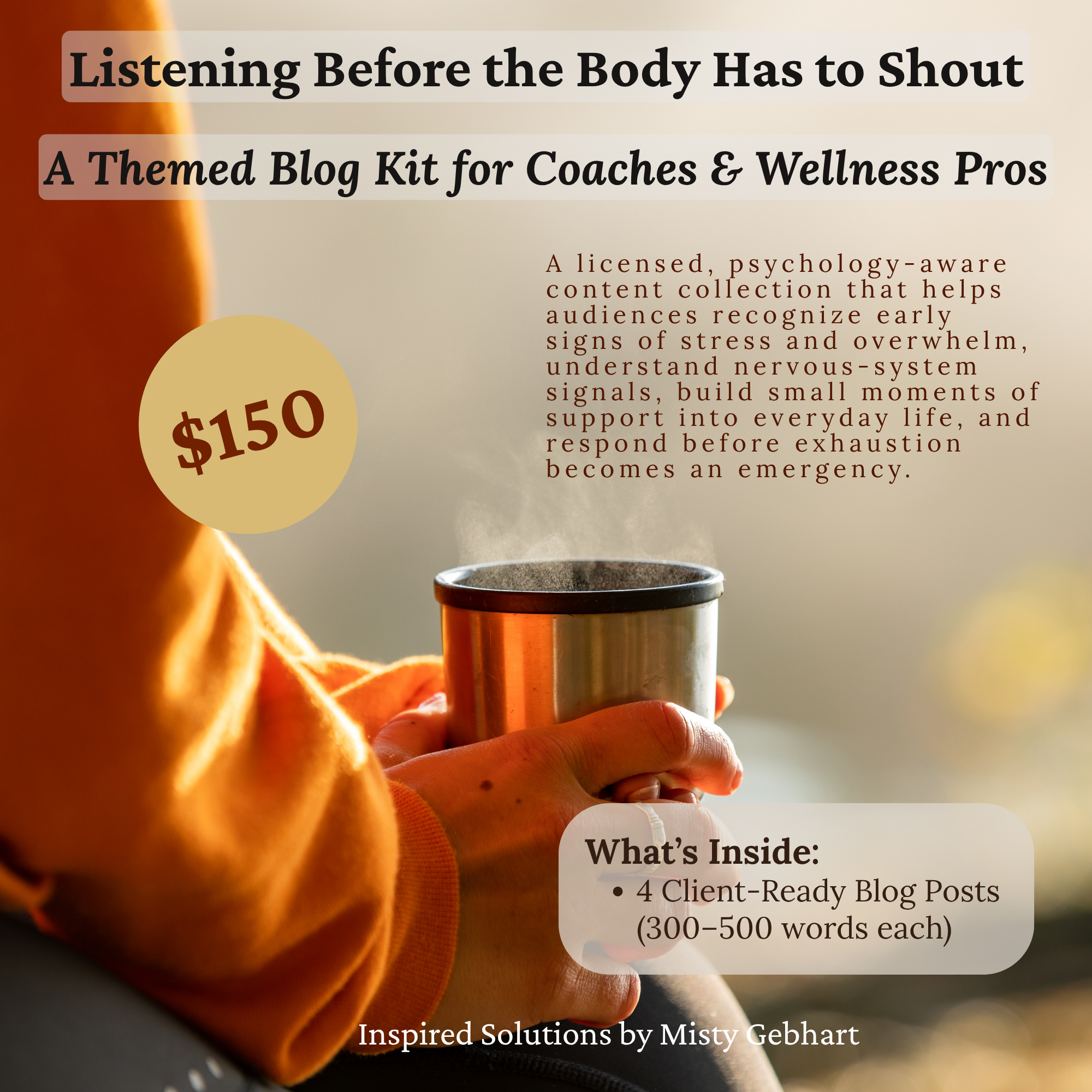
Listening Before the Body Has to Shout - Themed Blog Set
Give your audience wellness content that helps them notice strain before it becomes an emergency.
Overwhelm rarely arrives all at once.
It builds.
The shoulders stay a little tighter. Concentration gets harder. Patience gets shorter. Sleep doesn't restore quite as much. Everything begins to feel urgent. The body keeps offering information — but when stress has become part of everyday life, those early signals can be remarkably easy to dismiss.
Until they're not so easy to dismiss anymore.
Listening Before the Body Has to Shout offers a different approach.
This four-part licensed blog series helps readers recognize the quieter signs of accumulating stress, understand how small moments of support can interrupt constant activation, and make recovery part of ordinary life instead of something reserved for the point of exhaustion.
Four ready-to-publish wellness articles — already written.
Listening Before the Body Has to Shout is a licensed collection of four coordinated wellness articles for businesses and organizations that want deeper educational content around stress, overwhelm, nervous-system support, and preventive recovery without turning wellbeing into another complicated program people have to manage.
Rather than waiting until someone is running on empty, the series develops one larger idea:
The body often communicates that it needs support long before burnout or collapse becomes obvious. Learning to recognize and respond to those earlier signals creates an opportunity for support before rescue.
You publish the articles through your own channels, within your own branded environment, while retaining the original written content and required author attribution.
What's inside
4 coordinated, full-length wellness blog posts
One cohesive wellness theme
Ready-to-publish written content
Ongoing licensed use with your own audience
Freedom to format the articles within your own brand environment
Permission to add your own clearly separate business CTA before or after each article
$150 — one-time license fee
No subscription. No recurring charges.
One payment gives your business or organization licensed use of the complete four-part educational series with your own audience.
Publish the articles on your website or blog, include them in newsletters or email communications, share them through employee wellness communications or internal resource libraries, or provide them as educational content to your clients, patients, customers, or members.
The blog series
The First Signs Are Easy to Miss
Explores why overwhelm can be surprisingly difficult to recognize while it's building.
For many people, the earliest signs look ordinary: tight shoulders, frequent headaches, exhaustion, difficulty concentrating, irritability, racing thoughts, brain fog, restlessness, or the sense that everything suddenly needs attention at once.
When those experiences become familiar enough, they're easy to dismiss as just life.
This article helps readers distinguish between simply being busy and reaching a point where the demands on their time, attention, and emotional capacity exceed what they can comfortably hold.
It also reframes awareness itself.
Recognizing overwhelm isn't weakness. It doesn't mean someone is failing at life or becoming less capable.
It means they're noticing.
And noticing creates an opportunity to respond with rest, space, support, or a moment to breathe before the body has to work harder to get their attention.
Small Moments Can Change Everything
Challenges the assumption that meaningful stress support has to be substantial enough to require a free afternoon, a perfect routine, a weekend away, or a complete lifestyle reset.
Sometimes support is much smaller.
One slow breath before answering an email.
Relaxing shoulders that have crept upward.
Stepping outside between meetings.
Drinking a glass of water without rushing through it.
Holding a warm mug. Stretching after sitting too long. Listening to music. Sitting in sunlight for a minute before moving into the next task.
None of those actions eliminates the stressors in someone's life.
They're not supposed to.
This article explains how small experiences of calm, comfort, and support can give the nervous system something other than constant activation to experience — and why repetition can matter more than waiting for the perfect opportunity to recover.
The invitation isn't to do more self-care.
It's actually to think smaller.
Because support doesn't have to be elaborate to be meaningful.
Teaching the Body That It’s Safe
Explores the difference between intellectually knowing that nothing is wrong and physically feeling as though the body can soften.
Someone can have a secure home, stable work, supportive relationships, and no immediate crisis — while still noticing clenched muscles, restless movement, irritability, or a body that seems to remain prepared for whatever might happen next.
When stress becomes chronic, that state of anticipation can become familiar.
This article introduces the idea that safety isn't only an external condition. It can also be an internal experience that is reinforced gradually through repeated moments of support.
A slower breath. A walk outside. Relaxing the shoulders. Gentle movement. A kind word instead of criticism. Even a little humor that reminds the brain there is, in fact, no tiger currently giving chase.
The goal isn't to force relaxation or pretend stress doesn't exist.
It's to offer the body repeated experiences showing that support is available and softening is possible.
One gentle moment repeated often can begin teaching the body a different story.
Rest Before You Collapse
Draws an important distinction between two things that can look remarkably similar from the outside.
Rest and collapse both involve stopping.
But they are not the same experience.
Intentional rest is a choice. Collapse is what happens when the body makes the choice for you.
This article examines the tendency to postpone recovery until exhaustion, illness, brain fog, irritability, pain, or depleted capacity makes continuing increasingly difficult.
Rather than treating those signals as character flaws, it reframes them as information.
Readers are encouraged to build smaller periods of recovery into ordinary life — a genuine lunch break, a walk outside, a few intentional breaths, reading for pleasure, a quiet drink, or time away from technology — before strain reaches the point where stopping is no longer optional.
Because rest isn't the opposite of productivity.
It's part of what makes sustainable productivity possible.
The goal isn't discovering how much someone can endure before everything falls apart.
It's creating a life where recovery is part of the rhythm instead of the rescue plan.
Why this series works
Most people already know that chronic stress isn't ideal.
Knowing that doesn't necessarily help them recognize when ordinary stress is beginning to accumulate into something heavier.
That's where this series lives.
Listening Before the Body Has to Shout moves the conversation upstream.
Instead of beginning at burnout, it helps your audience:
Recognize physical, emotional, and mental signs of overwhelm earlier
Understand that meaningful nervous-system support can happen in very small moments
Create repeated experiences of support without expecting themselves to eliminate stress
Build recovery into everyday life before exhaustion makes stopping unavoidable
The result is practical stress education that doesn't require people to overhaul their lives, maintain perfect calm, or add an elaborate self-care routine to an already overloaded schedule.
Make it look at home in your brand — without rewriting the work.
The articles remain the authored work of Misty Gebhart | Inspired Chapter, but they can live naturally inside your existing communication channels.
Publish them using your own fonts, colors, layout, logo, headers, footers, and appropriate imagery. Add your own business information or CTA before or after the article as permitted by the included Themed Blog Set license.
The written articles themselves remain as provided, and the Inspired Chapter author attribution stays with each piece.
Use it throughout your content ecosystem
Publish one article each week to create a coordinated month-long conversation about stress awareness, nervous-system support, and preventive recovery.
Use an individual article when its subject fits what your audience needs. Include one in a newsletter. Add the complete series to an employee resource library. Share it with clients, patients, customers, or members alongside the services you already provide.
Each article stands on its own.
Together, they build a larger message:
Support doesn't have to wait until something becomes an emergency.
Want the complete campaign instead?
If you want to take Listening Before the Body Has to Shout beyond the four-blog series, the $249 Month-in-a-Box expands the same theme into a complete monthly wellness content system.
The full Month-in-a-Box includes the four supporting blogs plus:
The long-form anchor article "Listening Before the Body Has to Shout: Why Nervous System Support Begins Long Before Burnout — and How Small Moments of Care Can Change the Conversation", exploring early body signals, chronic activation, why stress becomes familiar, small experiences of safety, preventive rest, and collaboration with the body
A 28-day content planner moving through The Body Is Already Talking, Small Moments Matter, Safety Can Be Learned, and Support Before Rescue
Light assets including five quotes, two caption-ready posts, closing lines, visual direction, and six writing hooks
The employee- and client-facing "The Body Is Speaking: Creating Your Personal Early Warning Signal Map" guide, which helps users identify their own physical, emotional, and mental stress signals and the kinds of support that help them reset, recover, or reconnect
Choose the Themed Blog Set when you primarily need substantive educational articles for your existing content channels.
Choose the Month-in-a-Box when you want the larger stress-awareness and preventive-support conversation developed into a coordinated month-long content system.
Who this is for
Wellness businesses that want practical education around stress, overwhelm, and nervous-system support
HR and People Operations teams looking to address strain before the conversation reaches burnout
Healthcare and wellness professionals who want approachable educational content about recognizing early signs of overload
Internal Communications teams looking for useful wellbeing content employees can apply during ordinary workdays
Organizations that want to make recovery and support part of everyday wellbeing rather than an emergency response
Who this is not for
Organizations looking for clinical, therapeutic, diagnostic, or medical content
Businesses looking for private-label or ghostwritten content they can claim as their own
Teams that need to rewrite or substantially customize the articles
Anyone looking to resell, sublicense, transfer, or redistribute the content to another organization
A quick note about licensing
Your purchase licenses these four articles for publication to your own audience by one business, organization, or brand.
Copyright and authorship remain with Misty Gebhart / Inspired Chapter. The written content stays as provided, and the required Inspired Chapter author attribution remains with each published article.
The license does not include editing rights, white-label rights, resale rights, or the right to transfer the articles to another business or organization.
All content is the intellectual property of Inspired Chapter / Misty Gebhart and is provided under license. © 2026 Inspired Chapter. All Rights Reserved. Licensed, not sold.
Give your audience wellness content that helps them notice strain before it becomes an emergency.
Overwhelm rarely arrives all at once.
It builds.
The shoulders stay a little tighter. Concentration gets harder. Patience gets shorter. Sleep doesn't restore quite as much. Everything begins to feel urgent. The body keeps offering information — but when stress has become part of everyday life, those early signals can be remarkably easy to dismiss.
Until they're not so easy to dismiss anymore.
Listening Before the Body Has to Shout offers a different approach.
This four-part licensed blog series helps readers recognize the quieter signs of accumulating stress, understand how small moments of support can interrupt constant activation, and make recovery part of ordinary life instead of something reserved for the point of exhaustion.
Four ready-to-publish wellness articles — already written.
Listening Before the Body Has to Shout is a licensed collection of four coordinated wellness articles for businesses and organizations that want deeper educational content around stress, overwhelm, nervous-system support, and preventive recovery without turning wellbeing into another complicated program people have to manage.
Rather than waiting until someone is running on empty, the series develops one larger idea:
The body often communicates that it needs support long before burnout or collapse becomes obvious. Learning to recognize and respond to those earlier signals creates an opportunity for support before rescue.
You publish the articles through your own channels, within your own branded environment, while retaining the original written content and required author attribution.
What's inside
4 coordinated, full-length wellness blog posts
One cohesive wellness theme
Ready-to-publish written content
Ongoing licensed use with your own audience
Freedom to format the articles within your own brand environment
Permission to add your own clearly separate business CTA before or after each article
$150 — one-time license fee
No subscription. No recurring charges.
One payment gives your business or organization licensed use of the complete four-part educational series with your own audience.
Publish the articles on your website or blog, include them in newsletters or email communications, share them through employee wellness communications or internal resource libraries, or provide them as educational content to your clients, patients, customers, or members.
The blog series
The First Signs Are Easy to Miss
Explores why overwhelm can be surprisingly difficult to recognize while it's building.
For many people, the earliest signs look ordinary: tight shoulders, frequent headaches, exhaustion, difficulty concentrating, irritability, racing thoughts, brain fog, restlessness, or the sense that everything suddenly needs attention at once.
When those experiences become familiar enough, they're easy to dismiss as just life.
This article helps readers distinguish between simply being busy and reaching a point where the demands on their time, attention, and emotional capacity exceed what they can comfortably hold.
It also reframes awareness itself.
Recognizing overwhelm isn't weakness. It doesn't mean someone is failing at life or becoming less capable.
It means they're noticing.
And noticing creates an opportunity to respond with rest, space, support, or a moment to breathe before the body has to work harder to get their attention.
Small Moments Can Change Everything
Challenges the assumption that meaningful stress support has to be substantial enough to require a free afternoon, a perfect routine, a weekend away, or a complete lifestyle reset.
Sometimes support is much smaller.
One slow breath before answering an email.
Relaxing shoulders that have crept upward.
Stepping outside between meetings.
Drinking a glass of water without rushing through it.
Holding a warm mug. Stretching after sitting too long. Listening to music. Sitting in sunlight for a minute before moving into the next task.
None of those actions eliminates the stressors in someone's life.
They're not supposed to.
This article explains how small experiences of calm, comfort, and support can give the nervous system something other than constant activation to experience — and why repetition can matter more than waiting for the perfect opportunity to recover.
The invitation isn't to do more self-care.
It's actually to think smaller.
Because support doesn't have to be elaborate to be meaningful.
Teaching the Body That It’s Safe
Explores the difference between intellectually knowing that nothing is wrong and physically feeling as though the body can soften.
Someone can have a secure home, stable work, supportive relationships, and no immediate crisis — while still noticing clenched muscles, restless movement, irritability, or a body that seems to remain prepared for whatever might happen next.
When stress becomes chronic, that state of anticipation can become familiar.
This article introduces the idea that safety isn't only an external condition. It can also be an internal experience that is reinforced gradually through repeated moments of support.
A slower breath. A walk outside. Relaxing the shoulders. Gentle movement. A kind word instead of criticism. Even a little humor that reminds the brain there is, in fact, no tiger currently giving chase.
The goal isn't to force relaxation or pretend stress doesn't exist.
It's to offer the body repeated experiences showing that support is available and softening is possible.
One gentle moment repeated often can begin teaching the body a different story.
Rest Before You Collapse
Draws an important distinction between two things that can look remarkably similar from the outside.
Rest and collapse both involve stopping.
But they are not the same experience.
Intentional rest is a choice. Collapse is what happens when the body makes the choice for you.
This article examines the tendency to postpone recovery until exhaustion, illness, brain fog, irritability, pain, or depleted capacity makes continuing increasingly difficult.
Rather than treating those signals as character flaws, it reframes them as information.
Readers are encouraged to build smaller periods of recovery into ordinary life — a genuine lunch break, a walk outside, a few intentional breaths, reading for pleasure, a quiet drink, or time away from technology — before strain reaches the point where stopping is no longer optional.
Because rest isn't the opposite of productivity.
It's part of what makes sustainable productivity possible.
The goal isn't discovering how much someone can endure before everything falls apart.
It's creating a life where recovery is part of the rhythm instead of the rescue plan.
Why this series works
Most people already know that chronic stress isn't ideal.
Knowing that doesn't necessarily help them recognize when ordinary stress is beginning to accumulate into something heavier.
That's where this series lives.
Listening Before the Body Has to Shout moves the conversation upstream.
Instead of beginning at burnout, it helps your audience:
Recognize physical, emotional, and mental signs of overwhelm earlier
Understand that meaningful nervous-system support can happen in very small moments
Create repeated experiences of support without expecting themselves to eliminate stress
Build recovery into everyday life before exhaustion makes stopping unavoidable
The result is practical stress education that doesn't require people to overhaul their lives, maintain perfect calm, or add an elaborate self-care routine to an already overloaded schedule.
Make it look at home in your brand — without rewriting the work.
The articles remain the authored work of Misty Gebhart | Inspired Chapter, but they can live naturally inside your existing communication channels.
Publish them using your own fonts, colors, layout, logo, headers, footers, and appropriate imagery. Add your own business information or CTA before or after the article as permitted by the included Themed Blog Set license.
The written articles themselves remain as provided, and the Inspired Chapter author attribution stays with each piece.
Use it throughout your content ecosystem
Publish one article each week to create a coordinated month-long conversation about stress awareness, nervous-system support, and preventive recovery.
Use an individual article when its subject fits what your audience needs. Include one in a newsletter. Add the complete series to an employee resource library. Share it with clients, patients, customers, or members alongside the services you already provide.
Each article stands on its own.
Together, they build a larger message:
Support doesn't have to wait until something becomes an emergency.
Want the complete campaign instead?
If you want to take Listening Before the Body Has to Shout beyond the four-blog series, the $249 Month-in-a-Box expands the same theme into a complete monthly wellness content system.
The full Month-in-a-Box includes the four supporting blogs plus:
The long-form anchor article "Listening Before the Body Has to Shout: Why Nervous System Support Begins Long Before Burnout — and How Small Moments of Care Can Change the Conversation", exploring early body signals, chronic activation, why stress becomes familiar, small experiences of safety, preventive rest, and collaboration with the body
A 28-day content planner moving through The Body Is Already Talking, Small Moments Matter, Safety Can Be Learned, and Support Before Rescue
Light assets including five quotes, two caption-ready posts, closing lines, visual direction, and six writing hooks
The employee- and client-facing "The Body Is Speaking: Creating Your Personal Early Warning Signal Map" guide, which helps users identify their own physical, emotional, and mental stress signals and the kinds of support that help them reset, recover, or reconnect
Choose the Themed Blog Set when you primarily need substantive educational articles for your existing content channels.
Choose the Month-in-a-Box when you want the larger stress-awareness and preventive-support conversation developed into a coordinated month-long content system.
Who this is for
Wellness businesses that want practical education around stress, overwhelm, and nervous-system support
HR and People Operations teams looking to address strain before the conversation reaches burnout
Healthcare and wellness professionals who want approachable educational content about recognizing early signs of overload
Internal Communications teams looking for useful wellbeing content employees can apply during ordinary workdays
Organizations that want to make recovery and support part of everyday wellbeing rather than an emergency response
Who this is not for
Organizations looking for clinical, therapeutic, diagnostic, or medical content
Businesses looking for private-label or ghostwritten content they can claim as their own
Teams that need to rewrite or substantially customize the articles
Anyone looking to resell, sublicense, transfer, or redistribute the content to another organization
A quick note about licensing
Your purchase licenses these four articles for publication to your own audience by one business, organization, or brand.
Copyright and authorship remain with Misty Gebhart / Inspired Chapter. The written content stays as provided, and the required Inspired Chapter author attribution remains with each published article.
The license does not include editing rights, white-label rights, resale rights, or the right to transfer the articles to another business or organization.
All content is the intellectual property of Inspired Chapter / Misty Gebhart and is provided under license. © 2026 Inspired Chapter. All Rights Reserved. Licensed, not sold.