
 Image 1 of 1
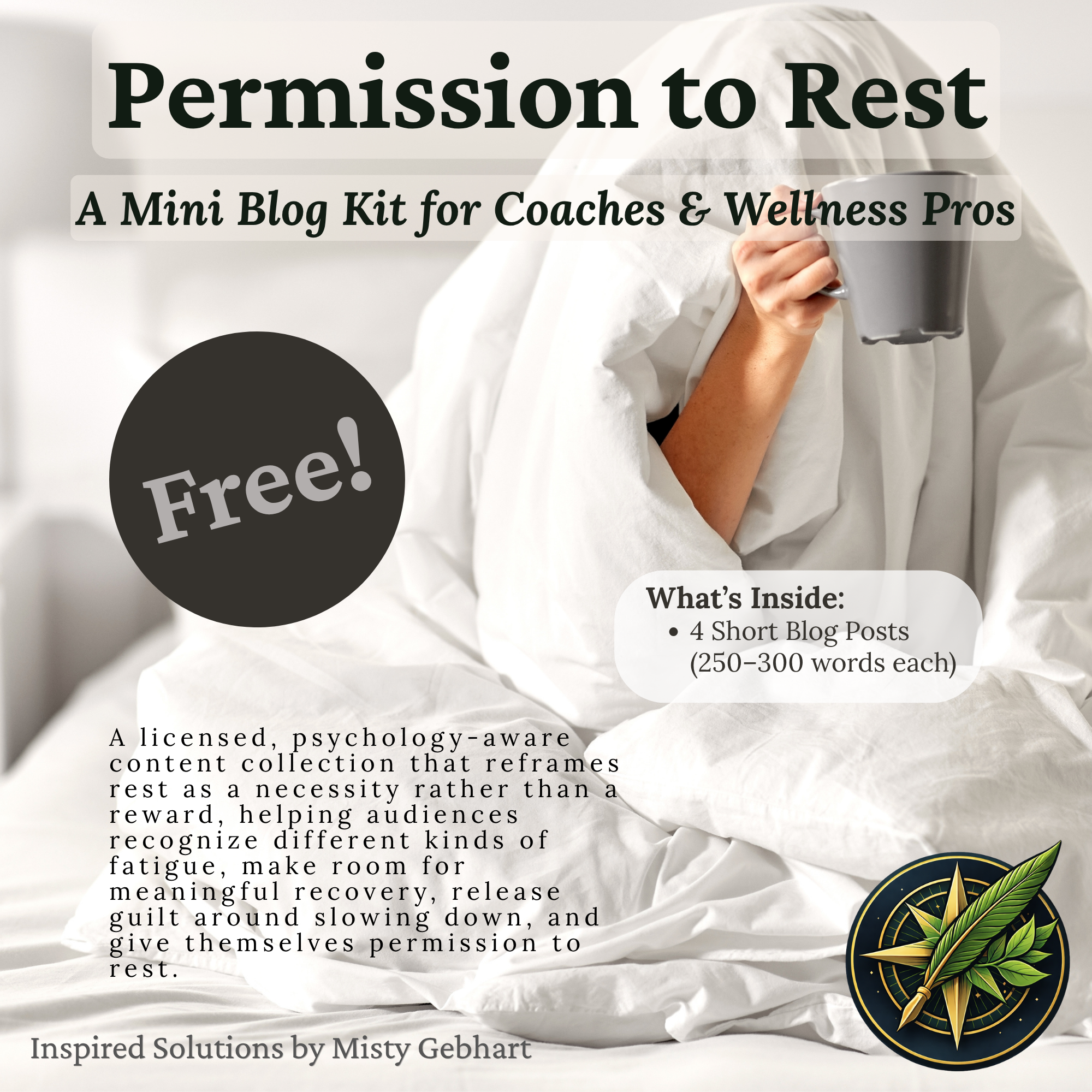
Permission to Rest - Mini Blog Set
Give your audience permission to stop before everything is finished.
Sometimes tired doesn't mean sleepy.
Sometimes the list isn't finished, but you've done enough for today.
Sometimes you finally sit down and immediately feel guilty about it.
And sometimes we've become so accustomed to justifying rest by what it will help us accomplish later that even recovery has somehow ended up with a job description.
Permission to Rest offers a different conversation.
This free four-part Mini Blog Set gives you short, ready-to-share wellness articles that help your audience understand different kinds of tiredness, find reasonable stopping points, recognize rest guilt without obeying it, and allow recovery to exist without having to prove its usefulness.
Four short wellness articles. Ready to share. Completely free.
The Permission to Rest Mini Blog Set was created for businesses, employers, wellness professionals, and organizations that want approachable, human-centered wellness content around rest and recovery.
Each article explores one ordinary barrier that can make stopping surprisingly difficult — even when someone knows they need a break.
No elaborate self-care routines.
No perfect evening rituals.
No requirement to finish everything first.
Just four practical reminders that rest belongs in real life too.
Publish the articles throughout the month or use them individually whenever the conversation fits your audience.
What's inside
4 short, ready-to-share wellness articles
One cohesive wellness theme
Practical, human-centered education
Licensed use with your own audience
Permission to publish across multiple approved channels
Indefinite use when the license terms are followed
$0 cost
Use them on your website or blog, in email newsletters, employee wellness communications, internal employee platforms, social media, or communications to your patients, clients, customers, or members.
Free — $0
No subscription. No trial period. No future payment required to keep using content you've legitimately obtained.
Download the set, follow the included Free Content License, and share the articles with your own audience.
As long as the license terms are followed, content legitimately obtained through the Free Content program may continue to be used indefinitely.
The Mini Blog Series
You Can Be Tired Without Being Sleepy
Starts with a familiar sentence:
I'm tired.
But tired can mean far more than needing a nap.
You may have slept perfectly well. Your body may not be sore. You may not even be yawning.
But one more decision feels unbearable.
You don't want anyone to ask another question.
Every sound suddenly seems much louder than it has any right to be.
That's tired too.
This article helps readers recognize that mental overload, social interaction, difficult emotions, noise, screens, notifications, and constant stimulation can all create forms of exhaustion that sleep alone may not resolve.
Instead of only asking:
Am I tired?
It introduces a more useful question:
What part of me feels tired?
Maybe the body needs sleep.
Maybe the brain needs twenty minutes without making a decision.
Maybe someone who's spent the entire day talking needs silence.
Maybe the person who has been emotionally available to everyone else needs a little time when nobody requires anything from them.
Because rest works better when it matches what has been working hardest.
An Unfinished List Doesn't Mean You Can't Stop
Addresses one of the most reliable ways to postpone rest indefinitely:
Waiting until everything is done.
There's another load of laundry.
Another email.
Something else to clean.
One more task that could supposedly make tomorrow easier.
The problem is that adult life is remarkably talented at producing replacement tasks.
Finish the laundry and eventually there will be more laundry.
Answer today's emails and tomorrow will bring new ones.
Clean the kitchen and — the absolute audacity — someone will eat in it again.
If completion is the requirement for rest, there will always be a reason to keep going.
This article gives readers permission to stop while something remains unfinished.
That doesn't mean responsibilities no longer matter.
An unfinished task isn't necessarily a neglected one.
Sometimes it simply means:
I'm done for today.
Readers are encouraged to recognize the difference between abandoning a responsibility and reaching a reasonable stopping point.
Because sometimes permission to rest sounds remarkably ordinary:
That's enough for today.
The harder part may simply be believing yourself when you say it.
Rest Guilt Doesn't Mean You're Doing Rest Wrong
Begins with the moment that should feel wonderful.
Nothing urgently needs your attention.
You have nowhere to be.
You finally sit down.
And your brain immediately starts offering helpful little suggestions.
You should fold the laundry.
You could answer that email.
You haven't done much today.
Well.
That's relaxing.
This article explores why rest can feel uncomfortable when productivity has been closely associated with responsibility for years.
Rather than assuming guilt means someone shouldn't be resting, it reframes that discomfort as something that can be noticed without being obeyed.
Yep, I feel like I should be doing something.
And then?
Remain seated.
That's practice too.
Readers don't have to completely unlearn productivity guilt before they're allowed to begin resting. The discomfort can still be muttering in the background while they read the book, take the nap, sit on the porch, or spend a little time doing absolutely nothing useful.
Because feeling uncomfortable about stopping doesn't automatically mean stopping was the wrong choice.
Sometimes it means you're learning that you don't have to earn the right to sit down.
Rest Doesn't Have to Produce Anything
Takes on a subtler problem hiding inside perfectly reasonable arguments for recovery.
Rest can improve focus.
Support creativity.
Increase patience.
Restore energy.
Help us return to our responsibilities better able to handle what comes next.
All true.
But if we're not careful, even those benefits can turn rest into another productivity strategy.
We rest so we can work harder later.
Take the break so we'll accomplish more afterward.
Sleep because tomorrow's performance will improve.
Suddenly, even recovery has a job.
This article asks what might happen if rest didn't always have to prove its usefulness.
What if sometimes someone rested simply because human beings require periods of effort and periods of recovery?
The nap doesn't need to make you productive.
The quiet evening doesn't need to improve tomorrow's output.
Sitting outside doesn't need to optimize your mood.
Those benefits may happen.
They simply don't have to be the justification.
Sometimes rest can simply be rest.
No outcome. No productivity calculation. No return on investment required.
Sometimes being a person who has carried enough for one day is reason enough.
Why offer Inspired Chapter content to your audience?
Most people don't need to be convinced that rest is healthy.
The harder part is applying that knowledge when life is unfinished, the brain is still busy, guilt appears the moment they stop, or recovery feels difficult to justify unless it makes them more productive afterward.
These Mini Blogs meet readers in those ordinary moments.
They give your audience approachable language for understanding why sleep isn't the only form of recovery, recognizing when enough really is enough, allowing guilt to exist without letting it dictate behavior, and remembering that rest doesn't need a measurable return to be worthwhile.
They're short enough to fit easily into the communication channels you already use while still giving readers something meaningful to carry with them.
And because they're already written and licensed for your direct audience, you can focus on sharing the conversation instead of creating it.
Publish it inside your own branded channels
Your website can still look like your website. Your newsletter can still look like your newsletter. Your social channels can still look like your business.
Ordinary visual formatting is permitted, and the Mini Blogs can appear within your normally branded environment.
The articles themselves remain Inspired Chapter content and must be published intact, including the supplied attribution and Inspired Chapter call to action.
Each article includes:
Written by Misty Gebhart | Inspired Chapter
More practical, human-centered wellness education from Inspired Chapter.
Those elements stay with the article when you publish it.
Want to go deeper?
The Mini Blog Set gives your audience an approachable introduction to the Permission to Rest conversation.
When you want more substantial content around the same theme, Inspired Chapter offers two licensed options:
The Themed Blog Set — $150
Four full-length wellness articles exploring different forms of rest, the belief that recovery must be earned, intentionally making room for recovery, and creating environments that make slowing down easier.
The Month-in-a-Box — $249
The complete Permission to Rest content system, including the long-form anchor article, four supporting blogs, a 28-day content planner, light assets, writing hooks, and the Permission Granted: A Guide to Recognizing, Receiving, and Responding to Your Need for Rest practical guide.
Start with what you need. Go deeper when it makes sense.
Who this is for
Wellness businesses that want approachable content around rest and recovery
HR and People Operations teams looking for practical employee wellbeing education
Healthcare and wellness professionals who want human-centered content that normalizes different kinds of rest
Small businesses without dedicated wellness content teams
Organizations that want to support healthier rhythms of effort and recovery without turning rest into another performance goal
Who this is not for
Anyone looking for white-label content
Anyone looking for content they can rewrite, repurpose, excerpt, or claim as their own
Businesses looking for content to resell or redistribute to other organizations
Anyone looking for clinical, therapeutic, diagnostic, medical, legal, financial, or individualized professional advice
A quick note about the Free Content License
Free doesn't mean public domain.
Your download gives you permission to publish and share these Mini Blogs with your own audience. The content must remain intact, including the supplied Inspired Chapter attribution and CTA, and cannot be rewritten, adapted, excerpted, resold, sublicensed, or transferred to another business or organization.
Each business or organization that wants to use the content must obtain its own copy directly from Inspired Chapter and agree to the Free Content License.
All content remains the intellectual property of Inspired Chapter and/or Misty Gebhart and is provided under license. © 2026 Inspired Chapter. All Rights Reserved.
Give your audience permission to stop before everything is finished.
Sometimes tired doesn't mean sleepy.
Sometimes the list isn't finished, but you've done enough for today.
Sometimes you finally sit down and immediately feel guilty about it.
And sometimes we've become so accustomed to justifying rest by what it will help us accomplish later that even recovery has somehow ended up with a job description.
Permission to Rest offers a different conversation.
This free four-part Mini Blog Set gives you short, ready-to-share wellness articles that help your audience understand different kinds of tiredness, find reasonable stopping points, recognize rest guilt without obeying it, and allow recovery to exist without having to prove its usefulness.
Four short wellness articles. Ready to share. Completely free.
The Permission to Rest Mini Blog Set was created for businesses, employers, wellness professionals, and organizations that want approachable, human-centered wellness content around rest and recovery.
Each article explores one ordinary barrier that can make stopping surprisingly difficult — even when someone knows they need a break.
No elaborate self-care routines.
No perfect evening rituals.
No requirement to finish everything first.
Just four practical reminders that rest belongs in real life too.
Publish the articles throughout the month or use them individually whenever the conversation fits your audience.
What's inside
4 short, ready-to-share wellness articles
One cohesive wellness theme
Practical, human-centered education
Licensed use with your own audience
Permission to publish across multiple approved channels
Indefinite use when the license terms are followed
$0 cost
Use them on your website or blog, in email newsletters, employee wellness communications, internal employee platforms, social media, or communications to your patients, clients, customers, or members.
Free — $0
No subscription. No trial period. No future payment required to keep using content you've legitimately obtained.
Download the set, follow the included Free Content License, and share the articles with your own audience.
As long as the license terms are followed, content legitimately obtained through the Free Content program may continue to be used indefinitely.
The Mini Blog Series
You Can Be Tired Without Being Sleepy
Starts with a familiar sentence:
I'm tired.
But tired can mean far more than needing a nap.
You may have slept perfectly well. Your body may not be sore. You may not even be yawning.
But one more decision feels unbearable.
You don't want anyone to ask another question.
Every sound suddenly seems much louder than it has any right to be.
That's tired too.
This article helps readers recognize that mental overload, social interaction, difficult emotions, noise, screens, notifications, and constant stimulation can all create forms of exhaustion that sleep alone may not resolve.
Instead of only asking:
Am I tired?
It introduces a more useful question:
What part of me feels tired?
Maybe the body needs sleep.
Maybe the brain needs twenty minutes without making a decision.
Maybe someone who's spent the entire day talking needs silence.
Maybe the person who has been emotionally available to everyone else needs a little time when nobody requires anything from them.
Because rest works better when it matches what has been working hardest.
An Unfinished List Doesn't Mean You Can't Stop
Addresses one of the most reliable ways to postpone rest indefinitely:
Waiting until everything is done.
There's another load of laundry.
Another email.
Something else to clean.
One more task that could supposedly make tomorrow easier.
The problem is that adult life is remarkably talented at producing replacement tasks.
Finish the laundry and eventually there will be more laundry.
Answer today's emails and tomorrow will bring new ones.
Clean the kitchen and — the absolute audacity — someone will eat in it again.
If completion is the requirement for rest, there will always be a reason to keep going.
This article gives readers permission to stop while something remains unfinished.
That doesn't mean responsibilities no longer matter.
An unfinished task isn't necessarily a neglected one.
Sometimes it simply means:
I'm done for today.
Readers are encouraged to recognize the difference between abandoning a responsibility and reaching a reasonable stopping point.
Because sometimes permission to rest sounds remarkably ordinary:
That's enough for today.
The harder part may simply be believing yourself when you say it.
Rest Guilt Doesn't Mean You're Doing Rest Wrong
Begins with the moment that should feel wonderful.
Nothing urgently needs your attention.
You have nowhere to be.
You finally sit down.
And your brain immediately starts offering helpful little suggestions.
You should fold the laundry.
You could answer that email.
You haven't done much today.
Well.
That's relaxing.
This article explores why rest can feel uncomfortable when productivity has been closely associated with responsibility for years.
Rather than assuming guilt means someone shouldn't be resting, it reframes that discomfort as something that can be noticed without being obeyed.
Yep, I feel like I should be doing something.
And then?
Remain seated.
That's practice too.
Readers don't have to completely unlearn productivity guilt before they're allowed to begin resting. The discomfort can still be muttering in the background while they read the book, take the nap, sit on the porch, or spend a little time doing absolutely nothing useful.
Because feeling uncomfortable about stopping doesn't automatically mean stopping was the wrong choice.
Sometimes it means you're learning that you don't have to earn the right to sit down.
Rest Doesn't Have to Produce Anything
Takes on a subtler problem hiding inside perfectly reasonable arguments for recovery.
Rest can improve focus.
Support creativity.
Increase patience.
Restore energy.
Help us return to our responsibilities better able to handle what comes next.
All true.
But if we're not careful, even those benefits can turn rest into another productivity strategy.
We rest so we can work harder later.
Take the break so we'll accomplish more afterward.
Sleep because tomorrow's performance will improve.
Suddenly, even recovery has a job.
This article asks what might happen if rest didn't always have to prove its usefulness.
What if sometimes someone rested simply because human beings require periods of effort and periods of recovery?
The nap doesn't need to make you productive.
The quiet evening doesn't need to improve tomorrow's output.
Sitting outside doesn't need to optimize your mood.
Those benefits may happen.
They simply don't have to be the justification.
Sometimes rest can simply be rest.
No outcome. No productivity calculation. No return on investment required.
Sometimes being a person who has carried enough for one day is reason enough.
Why offer Inspired Chapter content to your audience?
Most people don't need to be convinced that rest is healthy.
The harder part is applying that knowledge when life is unfinished, the brain is still busy, guilt appears the moment they stop, or recovery feels difficult to justify unless it makes them more productive afterward.
These Mini Blogs meet readers in those ordinary moments.
They give your audience approachable language for understanding why sleep isn't the only form of recovery, recognizing when enough really is enough, allowing guilt to exist without letting it dictate behavior, and remembering that rest doesn't need a measurable return to be worthwhile.
They're short enough to fit easily into the communication channels you already use while still giving readers something meaningful to carry with them.
And because they're already written and licensed for your direct audience, you can focus on sharing the conversation instead of creating it.
Publish it inside your own branded channels
Your website can still look like your website. Your newsletter can still look like your newsletter. Your social channels can still look like your business.
Ordinary visual formatting is permitted, and the Mini Blogs can appear within your normally branded environment.
The articles themselves remain Inspired Chapter content and must be published intact, including the supplied attribution and Inspired Chapter call to action.
Each article includes:
Written by Misty Gebhart | Inspired Chapter
More practical, human-centered wellness education from Inspired Chapter.
Those elements stay with the article when you publish it.
Want to go deeper?
The Mini Blog Set gives your audience an approachable introduction to the Permission to Rest conversation.
When you want more substantial content around the same theme, Inspired Chapter offers two licensed options:
The Themed Blog Set — $150
Four full-length wellness articles exploring different forms of rest, the belief that recovery must be earned, intentionally making room for recovery, and creating environments that make slowing down easier.
The Month-in-a-Box — $249
The complete Permission to Rest content system, including the long-form anchor article, four supporting blogs, a 28-day content planner, light assets, writing hooks, and the Permission Granted: A Guide to Recognizing, Receiving, and Responding to Your Need for Rest practical guide.
Start with what you need. Go deeper when it makes sense.
Who this is for
Wellness businesses that want approachable content around rest and recovery
HR and People Operations teams looking for practical employee wellbeing education
Healthcare and wellness professionals who want human-centered content that normalizes different kinds of rest
Small businesses without dedicated wellness content teams
Organizations that want to support healthier rhythms of effort and recovery without turning rest into another performance goal
Who this is not for
Anyone looking for white-label content
Anyone looking for content they can rewrite, repurpose, excerpt, or claim as their own
Businesses looking for content to resell or redistribute to other organizations
Anyone looking for clinical, therapeutic, diagnostic, medical, legal, financial, or individualized professional advice
A quick note about the Free Content License
Free doesn't mean public domain.
Your download gives you permission to publish and share these Mini Blogs with your own audience. The content must remain intact, including the supplied Inspired Chapter attribution and CTA, and cannot be rewritten, adapted, excerpted, resold, sublicensed, or transferred to another business or organization.
Each business or organization that wants to use the content must obtain its own copy directly from Inspired Chapter and agree to the Free Content License.
All content remains the intellectual property of Inspired Chapter and/or Misty Gebhart and is provided under license. © 2026 Inspired Chapter. All Rights Reserved.