
 Image 1 of 1
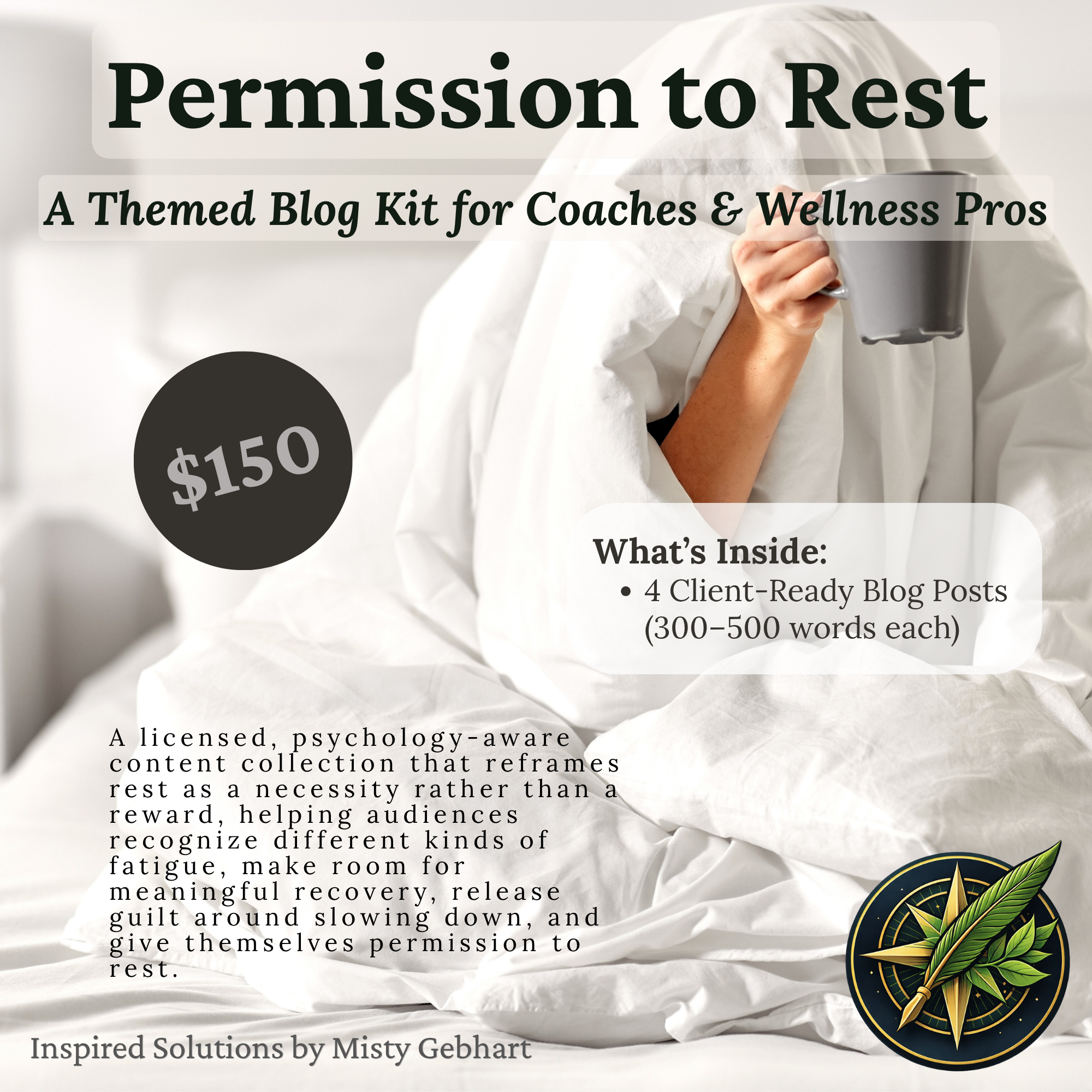
Permission to Rest - Themed Blog Set
Your audience already knows rest matters. Help them stop treating it like something they have to earn.
Most people don't need another reminder to get more sleep.
They need a more useful conversation about why recovery keeps getting postponed in the first place.
There's always another email. Another responsibility. Another person who needs something. Another item on the list.
And when productivity becomes intertwined with responsibility and worth, rest can begin to feel like something we're only entitled to after everything else is finished.
The problem?
Everything is almost never finished.
Permission to Rest helps your audience reconsider that pattern and build a healthier relationship with recovery — one that recognizes different kinds of fatigue, challenges rest guilt, intentionally protects restorative time, and creates environments that make slowing down easier.
Four ready-to-publish wellness articles — already written.
Permission to Rest is a licensed collection of four coordinated wellness articles for businesses and organizations that want deeper educational content around rest, recovery, sustainable wellbeing, and the beliefs that make slowing down difficult.
The series develops one larger idea:
Rest isn't a reward for finally doing enough. It's part of the rhythm that allows human beings to continue living, working, caring, and participating in their lives sustainably.
You publish the articles through your own channels, within your own branded environment, while retaining the original written content and required author attribution.
What's inside
4 coordinated, full-length wellness blog posts
One cohesive wellness theme
Ready-to-publish written content
Ongoing licensed use with your own audience
Freedom to format the articles within your own brand environment
Permission to add your own clearly separate business CTA before or after each article
$150 — one-time license fee
No subscription. No recurring charges.
One payment gives your business or organization licensed use of the complete four-part educational series with your own audience.
Publish the articles on your website or blog, include them in newsletters or email communications, share them through employee wellness communications or internal resource libraries, or provide them as educational content to your clients, patients, customers, or members.
The Blog Series
Rest Isn't Just Sleep
Starts by challenging one of the most common assumptions about recovery:
Tired doesn't always mean sleepy.
Physical fatigue may need sleep or stillness.
Mental fatigue may need relief from constant planning, decisions, and problem-solving.
Emotional fatigue may need space to acknowledge and process what's been carried.
Sensory fatigue may call for less noise, fewer screens, softer light, or time away from constant stimulation.
And social fatigue may simply mean needing some quiet after spending energy being present with other people.
This article helps readers recognize that different kinds of depletion require different kinds of recovery rather than treating every exhausted feeling as the same problem.
It gives them a simple question to begin with:
Where do I feel drained?
Because sometimes another hour of sleep isn't the missing piece.
The more useful response may be giving the part of you that's been working hardest the kind of rest it actually needs.
You Don't Have to Earn Rest
Addresses the guilt that can appear the moment we stop doing.
For many people, productivity has been reinforced for years.
Busy schedules are admired.
Accomplishment is rewarded.
Carrying more can become evidence that we're responsible, capable, committed, or successful.
So when we finally sit down, an uncomfortable thought appears:
There's something else I should be doing.
This article separates the body's need for recovery from the cultural belief that rest must be deserved.
Because if rest only becomes acceptable after the work, errands, caregiving, emails, projects, and obligations are complete, the finish line will simply keep moving.
Rest isn't something we earn by exhausting ourselves first.
It's one of the things that helps prevent exhaustion from becoming the price of participation in our lives.
The article also distinguishes recovery from laziness and reminds readers that caring for themselves isn't reserved for the moment when they've finally managed to care for everything else.
Make Room for Recovery
Takes the conversation from believing rest matters to actually giving it somewhere to exist.
When calendars fill with work, appointments, family responsibilities, deadlines, errands, and commitments, recovery is often assigned the least reliable spot:
Whenever there's time.
And somehow, there rarely is.
This article reframes rest as something that can be intentionally included in ordinary life rather than saved for an occasional free afternoon or a weekend when nothing else is happening.
A slow walk between meetings.
Five quiet minutes before opening email.
Stepping outside.
Stretching while coffee brews.
A short pause before the next responsibility.
These moments may be small, but they begin building recovery into the rhythm of a day.
The article also addresses something many readers will recognize immediately: we're often remarkably good at honoring commitments to other people while canceling the promises we've made to ourselves.
The invitation is simple:
You deserve a place on your own calendar.
Because recovery doesn't always require escaping from ordinary life.
Sometimes it begins by protecting a few minutes inside it.
Create a Space That Restores You
Expands the idea of recovery beyond what we do to include where we do it.
Our environments are constantly giving us information.
Clutter can keep unfinished tasks visually present.
Screens and competing noise can reinforce stimulation.
Harsh lighting may make settling difficult.
Meanwhile, a comfortable chair, softer light, an open window, familiar music, a favorite blanket, or a quiet corner can create very different cues.
This article explores how small environmental changes and repeated restorative rituals can help make slowing down easier.
Not because anyone needs a perfectly styled wellness sanctuary.
They don't even need an extra room.
Sometimes one chair by a window is enough.
Over time, familiar spaces and rituals can become signals associated with recovery — places where the mind and body begin to recognize:
I'm allowed to exhale here.
The goal isn't creating an impressive space.
It's creating a supportive one.
Why this series works
Rest is one of those wellness subjects that can sound incredibly simple from the outside.
You're tired? Rest.
But the actual barriers are often more complicated.
Someone may be sleeping while remaining mentally or emotionally exhausted. They may understand that they need recovery but feel guilty whenever they stop. They may continually postpone rest because the list isn't finished. Or their environment may make it difficult to shift out of constant stimulation even when they technically have time available.
Permission to Rest gives your audience a more complete conversation.
It helps them:
Identify what kind of rest may actually match the fatigue they're experiencing
Question the belief that recovery must be earned through productivity
Build small, intentional opportunities for rest into ordinary life
Create environmental cues and rituals that make restoration easier to receive
It doesn't ask people to abandon their responsibilities.
It helps them stop abandoning recovery while meeting them.
Make it look at home in your brand — without rewriting the work.
The articles remain the authored work of Misty Gebhart | Inspired Chapter, but they can live naturally inside your existing communication channels.
Publish them using your own fonts, colors, layout, logo, headers, footers, and appropriate imagery. Add your own business information or CTA before or after the article as permitted by the included Themed Blog Set license.
The written articles themselves remain as provided, and the Inspired Chapter author attribution stays with each piece.
Use it throughout your content ecosystem
Publish one article each week and create a month-long conversation about recovery.
Use Rest Isn't Just Sleep when your audience needs a broader understanding of fatigue.
Share You Don't Have to Earn Rest when guilt and productivity culture are the larger conversation.
Use Make Room for Recovery when you want something practical and immediately applicable.
And Create a Space That Restores You gives you an approachable way to talk about the role environment plays in wellbeing.
Each article works independently.
Together, they move readers from understanding rest to allowing it, protecting it, and making it easier to receive.
Want the complete campaign instead?
If you want to take Permission to Rest beyond the four-blog series, the $249 Month-in-a-Box expands the theme into a complete monthly wellness content system.
The full Month-in-a-Box includes the four supporting blogs plus:
The long-form anchor article “Permission to Rest: Why Recovery Is a Necessity, Not a Reward”, exploring why rest feels difficult, different forms of fatigue, productivity guilt, recovery as part of performance, supportive environments, boundaries, and giving ourselves permission before depletion forces the issue
A 28-day content planner moving through Rest Is Necessary, Recovery Looks Different, Make Room to Recover, and Choosing Permission
Light assets and writing prompts, including quotes, caption-ready posts, closing lines, visual direction, and audience-facing hooks
The practical guide “Permission Granted: A Guide to Recognizing, Receiving, and Responding to Your Need for Rest,” helping readers identify where they're postponing rest, determine what kind of recovery they need, and choose the permission they most need to give themselves
Choose the Themed Blog Set when you primarily need substantive educational articles for your existing content channels.
Choose the Month-in-a-Box when you want the larger rest and recovery conversation developed into a coordinated month-long content system.
Who this is for
Wellness businesses that want deeper educational content about rest and sustainable recovery
HR and People Operations teams addressing employee wellbeing without adding more performance pressure
Healthcare and wellness professionals looking for approachable, non-clinical recovery education
Internal Communications teams that want a more useful conversation than simply telling employees to practice self-care
Organizations that want to normalize healthier rhythms of effort and recovery
Who this is not for
Organizations looking for clinical, therapeutic, diagnostic, or medical content
Businesses looking for private-label or ghostwritten content they can claim as their own
Teams that need to rewrite or substantially customize the articles
Anyone looking to resell, sublicense, transfer, or redistribute the content to another organization
A quick note about licensing
Your purchase licenses these four articles for publication to your own audience by one business, organization, or brand.
Copyright and authorship remain with Misty Gebhart / Inspired Chapter. The written content stays as provided, and the required Inspired Chapter author attribution remains with each published article.
The license does not include editing rights, white-label rights, resale rights, or the right to transfer the articles to another business or organization.
All content is the intellectual property of Inspired Chapter / Misty Gebhart and is provided under license. © 2026 Inspired Chapter. All Rights Reserved. Licensed, not sold.
Your audience already knows rest matters. Help them stop treating it like something they have to earn.
Most people don't need another reminder to get more sleep.
They need a more useful conversation about why recovery keeps getting postponed in the first place.
There's always another email. Another responsibility. Another person who needs something. Another item on the list.
And when productivity becomes intertwined with responsibility and worth, rest can begin to feel like something we're only entitled to after everything else is finished.
The problem?
Everything is almost never finished.
Permission to Rest helps your audience reconsider that pattern and build a healthier relationship with recovery — one that recognizes different kinds of fatigue, challenges rest guilt, intentionally protects restorative time, and creates environments that make slowing down easier.
Four ready-to-publish wellness articles — already written.
Permission to Rest is a licensed collection of four coordinated wellness articles for businesses and organizations that want deeper educational content around rest, recovery, sustainable wellbeing, and the beliefs that make slowing down difficult.
The series develops one larger idea:
Rest isn't a reward for finally doing enough. It's part of the rhythm that allows human beings to continue living, working, caring, and participating in their lives sustainably.
You publish the articles through your own channels, within your own branded environment, while retaining the original written content and required author attribution.
What's inside
4 coordinated, full-length wellness blog posts
One cohesive wellness theme
Ready-to-publish written content
Ongoing licensed use with your own audience
Freedom to format the articles within your own brand environment
Permission to add your own clearly separate business CTA before or after each article
$150 — one-time license fee
No subscription. No recurring charges.
One payment gives your business or organization licensed use of the complete four-part educational series with your own audience.
Publish the articles on your website or blog, include them in newsletters or email communications, share them through employee wellness communications or internal resource libraries, or provide them as educational content to your clients, patients, customers, or members.
The Blog Series
Rest Isn't Just Sleep
Starts by challenging one of the most common assumptions about recovery:
Tired doesn't always mean sleepy.
Physical fatigue may need sleep or stillness.
Mental fatigue may need relief from constant planning, decisions, and problem-solving.
Emotional fatigue may need space to acknowledge and process what's been carried.
Sensory fatigue may call for less noise, fewer screens, softer light, or time away from constant stimulation.
And social fatigue may simply mean needing some quiet after spending energy being present with other people.
This article helps readers recognize that different kinds of depletion require different kinds of recovery rather than treating every exhausted feeling as the same problem.
It gives them a simple question to begin with:
Where do I feel drained?
Because sometimes another hour of sleep isn't the missing piece.
The more useful response may be giving the part of you that's been working hardest the kind of rest it actually needs.
You Don't Have to Earn Rest
Addresses the guilt that can appear the moment we stop doing.
For many people, productivity has been reinforced for years.
Busy schedules are admired.
Accomplishment is rewarded.
Carrying more can become evidence that we're responsible, capable, committed, or successful.
So when we finally sit down, an uncomfortable thought appears:
There's something else I should be doing.
This article separates the body's need for recovery from the cultural belief that rest must be deserved.
Because if rest only becomes acceptable after the work, errands, caregiving, emails, projects, and obligations are complete, the finish line will simply keep moving.
Rest isn't something we earn by exhausting ourselves first.
It's one of the things that helps prevent exhaustion from becoming the price of participation in our lives.
The article also distinguishes recovery from laziness and reminds readers that caring for themselves isn't reserved for the moment when they've finally managed to care for everything else.
Make Room for Recovery
Takes the conversation from believing rest matters to actually giving it somewhere to exist.
When calendars fill with work, appointments, family responsibilities, deadlines, errands, and commitments, recovery is often assigned the least reliable spot:
Whenever there's time.
And somehow, there rarely is.
This article reframes rest as something that can be intentionally included in ordinary life rather than saved for an occasional free afternoon or a weekend when nothing else is happening.
A slow walk between meetings.
Five quiet minutes before opening email.
Stepping outside.
Stretching while coffee brews.
A short pause before the next responsibility.
These moments may be small, but they begin building recovery into the rhythm of a day.
The article also addresses something many readers will recognize immediately: we're often remarkably good at honoring commitments to other people while canceling the promises we've made to ourselves.
The invitation is simple:
You deserve a place on your own calendar.
Because recovery doesn't always require escaping from ordinary life.
Sometimes it begins by protecting a few minutes inside it.
Create a Space That Restores You
Expands the idea of recovery beyond what we do to include where we do it.
Our environments are constantly giving us information.
Clutter can keep unfinished tasks visually present.
Screens and competing noise can reinforce stimulation.
Harsh lighting may make settling difficult.
Meanwhile, a comfortable chair, softer light, an open window, familiar music, a favorite blanket, or a quiet corner can create very different cues.
This article explores how small environmental changes and repeated restorative rituals can help make slowing down easier.
Not because anyone needs a perfectly styled wellness sanctuary.
They don't even need an extra room.
Sometimes one chair by a window is enough.
Over time, familiar spaces and rituals can become signals associated with recovery — places where the mind and body begin to recognize:
I'm allowed to exhale here.
The goal isn't creating an impressive space.
It's creating a supportive one.
Why this series works
Rest is one of those wellness subjects that can sound incredibly simple from the outside.
You're tired? Rest.
But the actual barriers are often more complicated.
Someone may be sleeping while remaining mentally or emotionally exhausted. They may understand that they need recovery but feel guilty whenever they stop. They may continually postpone rest because the list isn't finished. Or their environment may make it difficult to shift out of constant stimulation even when they technically have time available.
Permission to Rest gives your audience a more complete conversation.
It helps them:
Identify what kind of rest may actually match the fatigue they're experiencing
Question the belief that recovery must be earned through productivity
Build small, intentional opportunities for rest into ordinary life
Create environmental cues and rituals that make restoration easier to receive
It doesn't ask people to abandon their responsibilities.
It helps them stop abandoning recovery while meeting them.
Make it look at home in your brand — without rewriting the work.
The articles remain the authored work of Misty Gebhart | Inspired Chapter, but they can live naturally inside your existing communication channels.
Publish them using your own fonts, colors, layout, logo, headers, footers, and appropriate imagery. Add your own business information or CTA before or after the article as permitted by the included Themed Blog Set license.
The written articles themselves remain as provided, and the Inspired Chapter author attribution stays with each piece.
Use it throughout your content ecosystem
Publish one article each week and create a month-long conversation about recovery.
Use Rest Isn't Just Sleep when your audience needs a broader understanding of fatigue.
Share You Don't Have to Earn Rest when guilt and productivity culture are the larger conversation.
Use Make Room for Recovery when you want something practical and immediately applicable.
And Create a Space That Restores You gives you an approachable way to talk about the role environment plays in wellbeing.
Each article works independently.
Together, they move readers from understanding rest to allowing it, protecting it, and making it easier to receive.
Want the complete campaign instead?
If you want to take Permission to Rest beyond the four-blog series, the $249 Month-in-a-Box expands the theme into a complete monthly wellness content system.
The full Month-in-a-Box includes the four supporting blogs plus:
The long-form anchor article “Permission to Rest: Why Recovery Is a Necessity, Not a Reward”, exploring why rest feels difficult, different forms of fatigue, productivity guilt, recovery as part of performance, supportive environments, boundaries, and giving ourselves permission before depletion forces the issue
A 28-day content planner moving through Rest Is Necessary, Recovery Looks Different, Make Room to Recover, and Choosing Permission
Light assets and writing prompts, including quotes, caption-ready posts, closing lines, visual direction, and audience-facing hooks
The practical guide “Permission Granted: A Guide to Recognizing, Receiving, and Responding to Your Need for Rest,” helping readers identify where they're postponing rest, determine what kind of recovery they need, and choose the permission they most need to give themselves
Choose the Themed Blog Set when you primarily need substantive educational articles for your existing content channels.
Choose the Month-in-a-Box when you want the larger rest and recovery conversation developed into a coordinated month-long content system.
Who this is for
Wellness businesses that want deeper educational content about rest and sustainable recovery
HR and People Operations teams addressing employee wellbeing without adding more performance pressure
Healthcare and wellness professionals looking for approachable, non-clinical recovery education
Internal Communications teams that want a more useful conversation than simply telling employees to practice self-care
Organizations that want to normalize healthier rhythms of effort and recovery
Who this is not for
Organizations looking for clinical, therapeutic, diagnostic, or medical content
Businesses looking for private-label or ghostwritten content they can claim as their own
Teams that need to rewrite or substantially customize the articles
Anyone looking to resell, sublicense, transfer, or redistribute the content to another organization
A quick note about licensing
Your purchase licenses these four articles for publication to your own audience by one business, organization, or brand.
Copyright and authorship remain with Misty Gebhart / Inspired Chapter. The written content stays as provided, and the required Inspired Chapter author attribution remains with each published article.
The license does not include editing rights, white-label rights, resale rights, or the right to transfer the articles to another business or organization.
All content is the intellectual property of Inspired Chapter / Misty Gebhart and is provided under license. © 2026 Inspired Chapter. All Rights Reserved. Licensed, not sold.