
 Image 1 of 1
Protecting Your Capacity - Mini Blog Set
Help your audience think beyond how much time they have — and notice what their lives actually require from them.
An hour isn't always expensive.
Five minutes isn't always cheap.
Something wonderful can still leave you exhausted. The amount you could carry yesterday may have very little to do with what you can comfortably carry today. And sometimes the energy you've worked hard to restore doesn't need to be immediately converted into more productivity.
Protecting Your Capacity brings those distinctions into everyday life.
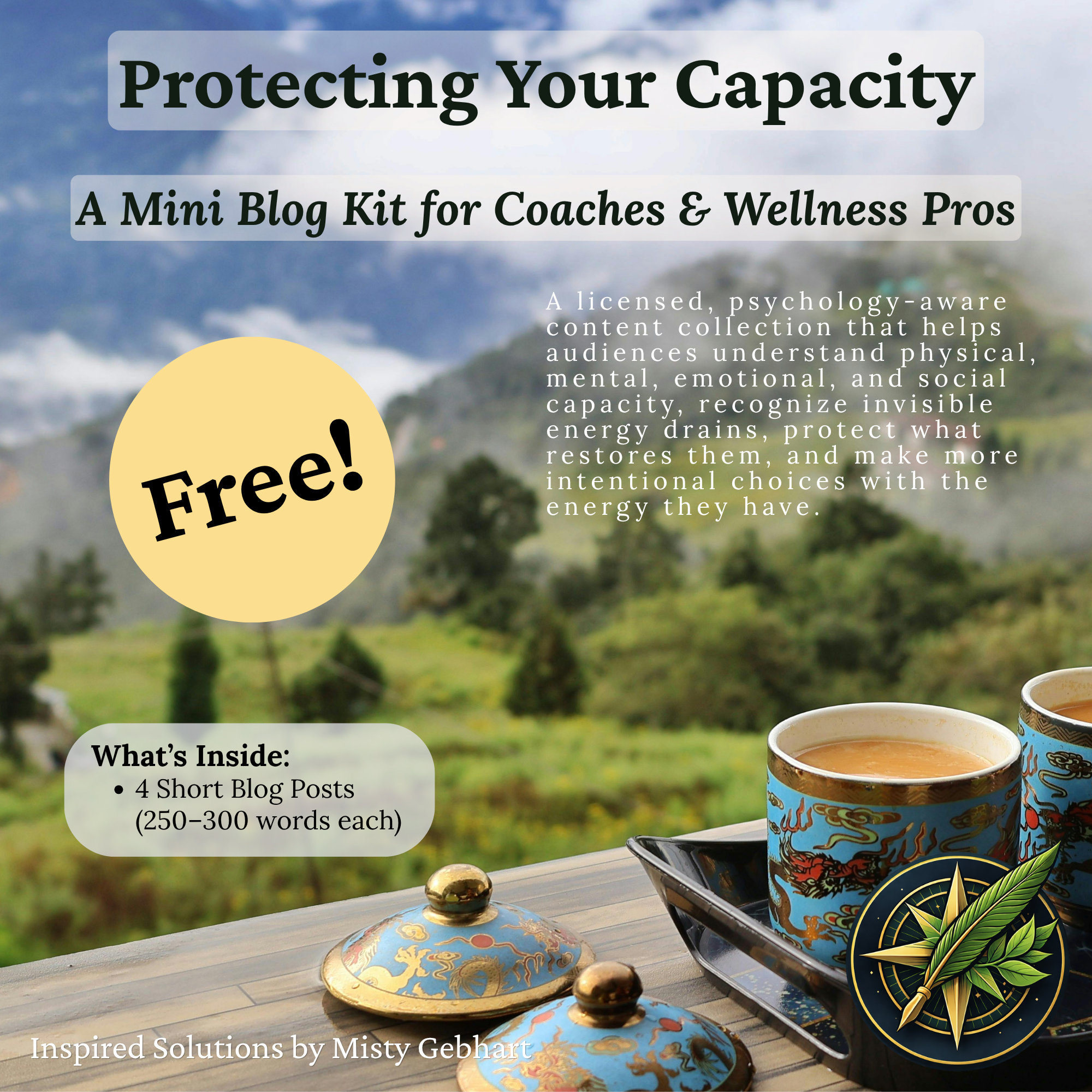
This free four-part Mini Blog Set gives you short, ready-to-share wellness articles that help your audience understand their energy with more nuance — and respond to it with less judgment.
Four short wellness articles. Ready to share. Completely free.
The Protecting Your Capacity Mini Blog Set was created for businesses, employers, wellness professionals, and organizations that want approachable, human-centered wellness content around energy, recovery, and sustainable capacity.
Each article explores one small but meaningful shift in how we understand the resources required to move through ordinary life.
No productivity hacks.
No instructions to squeeze more out of the day.
Just practical education that helps people become more aware of what different experiences cost — and what they may need afterward.
What's inside
4 short, ready-to-share wellness articles
One cohesive wellness theme
Practical, human-centered education
Licensed use with your own audience
Permission to publish across multiple approved channels
Indefinite use when the license terms are followed
$0 cost
Use them on your website or blog, in email newsletters, employee wellness communications, internal employee platforms, social media, or communications to your patients, clients, customers, or members.
Free — $0
No subscription. No trial period. No future payment required to keep using content you've legitimately obtained.
Download the set, follow the included Free Content License, and share the articles with your own audience.
As long as the license terms are followed, content legitimately obtained through the Free Content program may continue to be used indefinitely.
The Mini Blog Series
Five Minutes Can Cost More Than an Hour
Starts with one of the central ideas behind the entire capacity conversation:
Time doesn't tell us what something required.
An hour-long coffee with someone you love might leave you feeling better than when you arrived.
A five-minute argument can follow you around for the rest of the afternoon.
A tense conversation, a difficult decision, an upsetting message, trying to keep someone happy, or repeatedly switching attention between interruptions may occupy very little space on the calendar while using an enormous amount of energy.
Meanwhile, an entire evening spent doing something restorative may give more than it takes.
This article helps readers consider energy cost alongside time when planning their days.
We can't always arrange life perfectly around our capacity. But recognizing that different experiences have different costs can change how we understand our own tiredness.
Because sometimes the smallest thing on the calendar is carrying the biggest price tag.
Today's Capacity Doesn't Owe You Yesterday's Performance
Addresses the frustration of being highly capable one day and finding ordinary tasks strangely difficult the next.
Yesterday, everything got done.
Today, one more email feels unreasonable.
What happened?
Maybe nothing.
Capacity isn't a fixed setting.
Sleep, worry, emotional load, work demands, decision fatigue, and countless other conditions affect the resources available to us on a particular day.
That doesn't mean every lower-capacity day requires abandoning responsibilities. Sometimes things still need to be done.
But this article gives readers permission not to add judgment to an already demanding day.
Instead of:
Why can't I handle this today?
Try:
What am I carrying today?
That shift moves the conversation from character to context.
Some days have room for extra.
Some days the essentials are plenty.
Neither is a verdict on someone's capability, commitment, or work ethic.
Yesterday's capacity belonged to yesterday. Today's deserves to be met where it actually is.
A Good Thing Can Still Cost Energy
Makes room for a nuance that often gets lost in conversations about what "drains" us.
Not everything that costs energy is bad.
You can love your family and need quiet after spending the day together.
Enjoy your friends and still feel socially exhausted.
Care deeply about your work and need recovery from it.
Be thrilled about a trip and return home depleted.
Volunteer for something meaningful and still recognize how much it required from you.
This article challenges the assumption that feeling tired after something good means we didn't enjoy it enough or aren't sufficiently grateful.
Something can be completely worth your energy and still require recovery afterward.
Recognizing the cost doesn't mean regretting how the energy was spent.
It simply gives readers better information about what they may need next — whether that's a quieter evening, fewer errands, additional rest, or simply acknowledging that something meaningful took something out of them too.
Sometimes the same experience can drain us and restore us.
Human beings are inconveniently nuanced like that. 😏
Restored Energy Is Allowed to Stay Restored
Takes aim at a sneaky pattern many people may recognize immediately.
You finally rest.
Sleep a little more.
Read.
Spend time outside.
Have a genuinely quiet weekend.
And the moment you begin feeling better?
Excellent. Look at all this new capacity we can fill!
We catch up on sleep and overbook ourselves.
Say no because we're overwhelmed, then feel guilty about the empty space and put something else there.
Take a break — and immediately use the energy it created to do more.
This article offers a deceptively simple permission:
Restored energy is allowed to stay restored.
Energy is meant to be used. Protecting capacity isn't about hoarding it or withdrawing from things that matter.
But there is a difference between intentionally spending energy and automatically giving away everything we've managed to recover.
Readers are invited to notice what happens after something restores them.
Do they protect any of that renewed capacity?
Or does feeling better immediately become permission to pile things back on?
Sometimes protecting energy isn't about finding another way to recharge.
It's allowing the recharge you've already had to last a little longer.
Why offer Inspired Chapter content to your audience?
A lot of wellness advice talks about energy as though the solution is simply finding more of it.
Sleep better.
Recharge.
Take a break.
Practice self-care.
Those things can matter.
But Protecting Your Capacity adds another layer: understanding where energy actually goes, recognizing that capacity changes, accounting for the cost of meaningful experiences, and protecting some of what restoration gives back.
These Mini Blogs are short enough to fit easily into the communication channels you already use while still giving your audience something substantial to think about.
And because they're already written and licensed for your direct audience, you can focus on sharing the conversation instead of creating it.
Publish it inside your own branded channels
Your website can still look like your website. Your newsletter can still look like your newsletter. Your social channels can still look like your business.
Ordinary visual formatting is permitted, and the Mini Blogs can appear within your normally branded environment.
The articles themselves remain Inspired Chapter content and must be published intact, including the supplied attribution and Inspired Chapter call to action.
Each article includes:
Written by Misty Gebhart | Inspired Chapter
More practical, human-centered wellness education from Inspired Chapter.
Those elements stay with the article when you publish it.
Want to go deeper?
The Mini Blog Set gives your audience an approachable introduction to the Protecting Your Capacity conversation.
When you want more substantial content around the same theme, Inspired Chapter offers two licensed options:
The Themed Blog Set — $150
Four full-length wellness articles exploring different energetic costs, invisible emotional labor, honoring changing capacity, and protecting the experiences that restore us.
The Month-in-a-Box — $249
The complete Protecting Your Capacity content system, including the long-form anchor article, four supporting blogs, a 28-day content planner, light assets, writing hooks, and My Capacity Blueprint: A Practical Guide to Recognizing, Protecting, and Stewarding Your Energy.
Start with what you need. Go deeper when it makes sense.
Who this is for
Wellness businesses that want practical, accessible content around energy and capacity
HR and People Operations teams looking for employee wellbeing education beyond traditional time-management advice
Healthcare and wellness professionals who want human-centered content about sustainable energy and recovery
Small businesses without dedicated wellness content teams
Organizations that want to acknowledge mental, emotional, physical, and social demands without promoting hustle culture
Who this is not for
Anyone looking for white-label content
Anyone looking for content they can rewrite, repurpose, excerpt, or claim as their own
Businesses looking for content to resell or redistribute to other organizations
Anyone looking for clinical, therapeutic, diagnostic, medical, legal, financial, or individualized professional advice
A quick note about the Free Content License
Free doesn't mean public domain.
Your download gives you permission to publish and share these Mini Blogs with your own audience. The content must remain intact, including the supplied Inspired Chapter attribution and CTA, and cannot be rewritten, adapted, excerpted, resold, sublicensed, or transferred to another business or organization.
Each business or organization that wants to use the content must obtain its own copy directly from Inspired Chapter and agree to the Free Content License.
All content remains the intellectual property of Inspired Chapter and/or Misty Gebhart and is provided under license. © 2026 Inspired Chapter. All Rights Reserved.
Help your audience think beyond how much time they have — and notice what their lives actually require from them.
An hour isn't always expensive.
Five minutes isn't always cheap.
Something wonderful can still leave you exhausted. The amount you could carry yesterday may have very little to do with what you can comfortably carry today. And sometimes the energy you've worked hard to restore doesn't need to be immediately converted into more productivity.
Protecting Your Capacity brings those distinctions into everyday life.
This free four-part Mini Blog Set gives you short, ready-to-share wellness articles that help your audience understand their energy with more nuance — and respond to it with less judgment.
Four short wellness articles. Ready to share. Completely free.
The Protecting Your Capacity Mini Blog Set was created for businesses, employers, wellness professionals, and organizations that want approachable, human-centered wellness content around energy, recovery, and sustainable capacity.
Each article explores one small but meaningful shift in how we understand the resources required to move through ordinary life.
No productivity hacks.
No instructions to squeeze more out of the day.
Just practical education that helps people become more aware of what different experiences cost — and what they may need afterward.
What's inside
4 short, ready-to-share wellness articles
One cohesive wellness theme
Practical, human-centered education
Licensed use with your own audience
Permission to publish across multiple approved channels
Indefinite use when the license terms are followed
$0 cost
Use them on your website or blog, in email newsletters, employee wellness communications, internal employee platforms, social media, or communications to your patients, clients, customers, or members.
Free — $0
No subscription. No trial period. No future payment required to keep using content you've legitimately obtained.
Download the set, follow the included Free Content License, and share the articles with your own audience.
As long as the license terms are followed, content legitimately obtained through the Free Content program may continue to be used indefinitely.
The Mini Blog Series
Five Minutes Can Cost More Than an Hour
Starts with one of the central ideas behind the entire capacity conversation:
Time doesn't tell us what something required.
An hour-long coffee with someone you love might leave you feeling better than when you arrived.
A five-minute argument can follow you around for the rest of the afternoon.
A tense conversation, a difficult decision, an upsetting message, trying to keep someone happy, or repeatedly switching attention between interruptions may occupy very little space on the calendar while using an enormous amount of energy.
Meanwhile, an entire evening spent doing something restorative may give more than it takes.
This article helps readers consider energy cost alongside time when planning their days.
We can't always arrange life perfectly around our capacity. But recognizing that different experiences have different costs can change how we understand our own tiredness.
Because sometimes the smallest thing on the calendar is carrying the biggest price tag.
Today's Capacity Doesn't Owe You Yesterday's Performance
Addresses the frustration of being highly capable one day and finding ordinary tasks strangely difficult the next.
Yesterday, everything got done.
Today, one more email feels unreasonable.
What happened?
Maybe nothing.
Capacity isn't a fixed setting.
Sleep, worry, emotional load, work demands, decision fatigue, and countless other conditions affect the resources available to us on a particular day.
That doesn't mean every lower-capacity day requires abandoning responsibilities. Sometimes things still need to be done.
But this article gives readers permission not to add judgment to an already demanding day.
Instead of:
Why can't I handle this today?
Try:
What am I carrying today?
That shift moves the conversation from character to context.
Some days have room for extra.
Some days the essentials are plenty.
Neither is a verdict on someone's capability, commitment, or work ethic.
Yesterday's capacity belonged to yesterday. Today's deserves to be met where it actually is.
A Good Thing Can Still Cost Energy
Makes room for a nuance that often gets lost in conversations about what "drains" us.
Not everything that costs energy is bad.
You can love your family and need quiet after spending the day together.
Enjoy your friends and still feel socially exhausted.
Care deeply about your work and need recovery from it.
Be thrilled about a trip and return home depleted.
Volunteer for something meaningful and still recognize how much it required from you.
This article challenges the assumption that feeling tired after something good means we didn't enjoy it enough or aren't sufficiently grateful.
Something can be completely worth your energy and still require recovery afterward.
Recognizing the cost doesn't mean regretting how the energy was spent.
It simply gives readers better information about what they may need next — whether that's a quieter evening, fewer errands, additional rest, or simply acknowledging that something meaningful took something out of them too.
Sometimes the same experience can drain us and restore us.
Human beings are inconveniently nuanced like that. 😏
Restored Energy Is Allowed to Stay Restored
Takes aim at a sneaky pattern many people may recognize immediately.
You finally rest.
Sleep a little more.
Read.
Spend time outside.
Have a genuinely quiet weekend.
And the moment you begin feeling better?
Excellent. Look at all this new capacity we can fill!
We catch up on sleep and overbook ourselves.
Say no because we're overwhelmed, then feel guilty about the empty space and put something else there.
Take a break — and immediately use the energy it created to do more.
This article offers a deceptively simple permission:
Restored energy is allowed to stay restored.
Energy is meant to be used. Protecting capacity isn't about hoarding it or withdrawing from things that matter.
But there is a difference between intentionally spending energy and automatically giving away everything we've managed to recover.
Readers are invited to notice what happens after something restores them.
Do they protect any of that renewed capacity?
Or does feeling better immediately become permission to pile things back on?
Sometimes protecting energy isn't about finding another way to recharge.
It's allowing the recharge you've already had to last a little longer.
Why offer Inspired Chapter content to your audience?
A lot of wellness advice talks about energy as though the solution is simply finding more of it.
Sleep better.
Recharge.
Take a break.
Practice self-care.
Those things can matter.
But Protecting Your Capacity adds another layer: understanding where energy actually goes, recognizing that capacity changes, accounting for the cost of meaningful experiences, and protecting some of what restoration gives back.
These Mini Blogs are short enough to fit easily into the communication channels you already use while still giving your audience something substantial to think about.
And because they're already written and licensed for your direct audience, you can focus on sharing the conversation instead of creating it.
Publish it inside your own branded channels
Your website can still look like your website. Your newsletter can still look like your newsletter. Your social channels can still look like your business.
Ordinary visual formatting is permitted, and the Mini Blogs can appear within your normally branded environment.
The articles themselves remain Inspired Chapter content and must be published intact, including the supplied attribution and Inspired Chapter call to action.
Each article includes:
Written by Misty Gebhart | Inspired Chapter
More practical, human-centered wellness education from Inspired Chapter.
Those elements stay with the article when you publish it.
Want to go deeper?
The Mini Blog Set gives your audience an approachable introduction to the Protecting Your Capacity conversation.
When you want more substantial content around the same theme, Inspired Chapter offers two licensed options:
The Themed Blog Set — $150
Four full-length wellness articles exploring different energetic costs, invisible emotional labor, honoring changing capacity, and protecting the experiences that restore us.
The Month-in-a-Box — $249
The complete Protecting Your Capacity content system, including the long-form anchor article, four supporting blogs, a 28-day content planner, light assets, writing hooks, and My Capacity Blueprint: A Practical Guide to Recognizing, Protecting, and Stewarding Your Energy.
Start with what you need. Go deeper when it makes sense.
Who this is for
Wellness businesses that want practical, accessible content around energy and capacity
HR and People Operations teams looking for employee wellbeing education beyond traditional time-management advice
Healthcare and wellness professionals who want human-centered content about sustainable energy and recovery
Small businesses without dedicated wellness content teams
Organizations that want to acknowledge mental, emotional, physical, and social demands without promoting hustle culture
Who this is not for
Anyone looking for white-label content
Anyone looking for content they can rewrite, repurpose, excerpt, or claim as their own
Businesses looking for content to resell or redistribute to other organizations
Anyone looking for clinical, therapeutic, diagnostic, medical, legal, financial, or individualized professional advice
A quick note about the Free Content License
Free doesn't mean public domain.
Your download gives you permission to publish and share these Mini Blogs with your own audience. The content must remain intact, including the supplied Inspired Chapter attribution and CTA, and cannot be rewritten, adapted, excerpted, resold, sublicensed, or transferred to another business or organization.
Each business or organization that wants to use the content must obtain its own copy directly from Inspired Chapter and agree to the Free Content License.
All content remains the intellectual property of Inspired Chapter and/or Misty Gebhart and is provided under license. © 2026 Inspired Chapter. All Rights Reserved.