
 Image 1 of 1
Protecting Your Capacity - Themed Blog Set
Your audience knows how to manage their time. Help them understand what their time actually costs.
A calendar can tell you whether you have an hour available.
It can't tell you whether you have the capacity for what you're about to put in it.
A five-minute conversation can drain more energy than an hour spent doing something you enjoy. Emotional labor can consume resources without ever appearing on a schedule. And sometimes we restore ourselves beautifully — only to spend every bit of that renewed energy the moment we feel better.
Protecting Your Capacity helps your audience look beyond hours and obligations to something harder to measure but just as important:
What is this asking from me — and what do I need in order to keep showing up sustainably?
Four ready-to-publish wellness articles — already written.
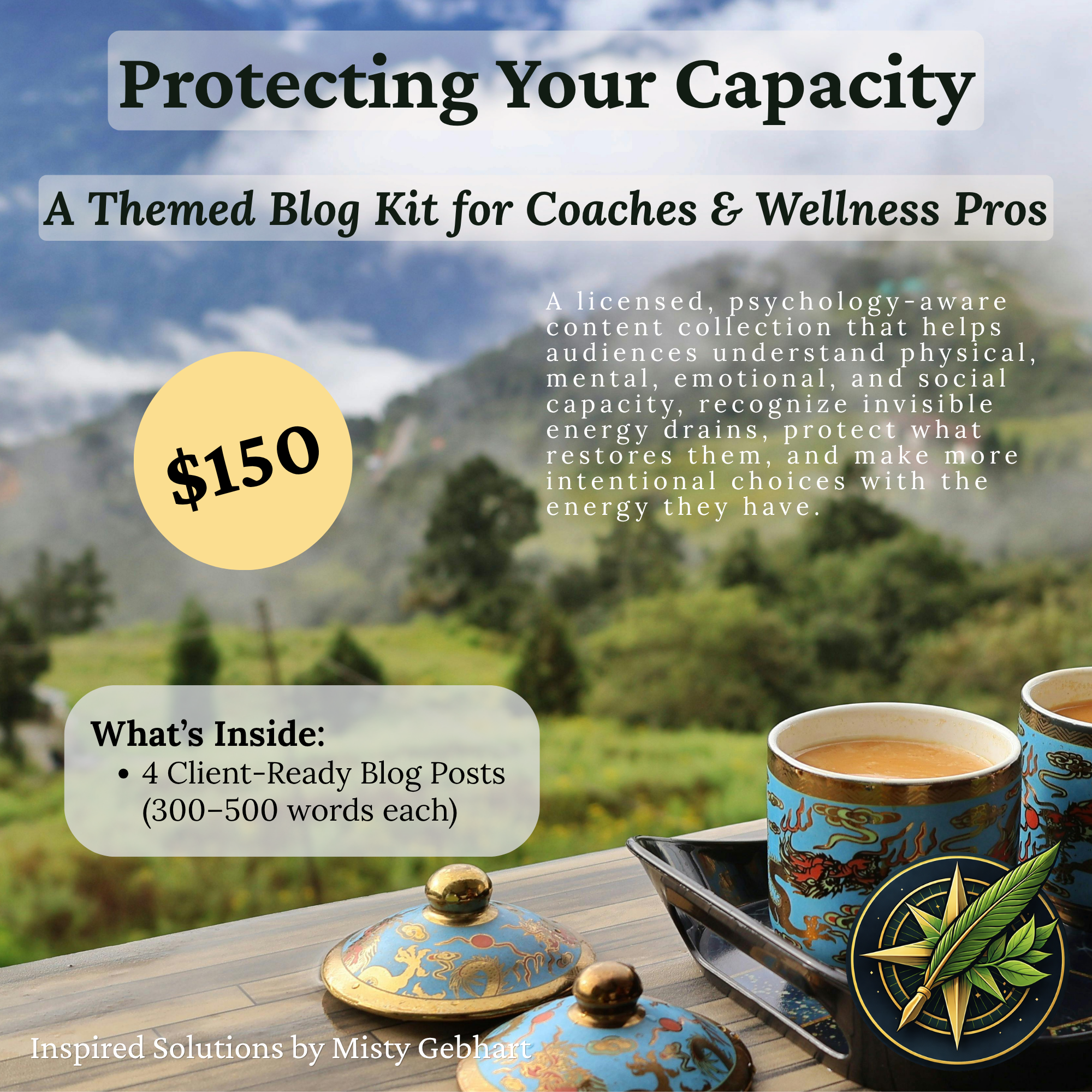
Protecting Your Capacity is a licensed collection of four coordinated wellness articles for businesses and organizations that want deeper educational content around energy, emotional load, boundaries, recovery, and sustainable wellbeing.
The series develops one larger idea:
Capacity includes the physical, mental, emotional, and social resources we use to navigate everyday life. Those resources are finite, they change with our circumstances, and protecting them requires more than simply managing the hours on a calendar.
You publish the articles through your own channels, within your own branded environment, while retaining the original written content and required author attribution.
What's inside
4 coordinated, full-length wellness blog posts
One cohesive wellness theme
Ready-to-publish written content
Ongoing licensed use with your own audience
Freedom to format the articles within your own brand environment
Permission to add your own clearly separate business CTA before or after each article
$150 — one-time license fee
No subscription. No recurring charges.
One payment gives your business or organization licensed use of the complete four-part educational series with your own audience.
Publish the articles on your website or blog, include them in newsletters or email communications, share them through employee wellness communications or internal resource libraries, or provide them as educational content to your clients, patients, customers, or members.
The Blog Series
Not Everything Costs the Same
Challenges one of the simplest assumptions we make about our days:
If something doesn't take much time, it shouldn't take much energy.
But time and capacity aren't interchangeable.
Clutter that repeatedly pulls at attention. Constant negativity. Busy work. Overthinking. Emotionally heavy conversations. A few minutes of conflict that stays with you for hours.
These experiences may take very little time while requiring a surprising amount of energy.
The opposite can also be true. A long walk, time in the garden, an unhurried conversation, reading, or sitting quietly with a cup of coffee may occupy more time while leaving someone feeling restored.
This article helps readers begin noticing that difference rather than judging tiredness according to how busy the calendar looked.
It also acknowledges that not every drain can or should be eliminated. Work, family, caregiving, and difficult seasons can be deeply worthwhile while still costing energy.
The goal is awareness of the cost — so recovery can become intentional rather than something we wait to consider after we're already depleted.
The Energy You Can't See
Explores the forms of exhaustion that are much harder to explain because they don't leave obvious evidence.
Mental and emotional energy are used every time we make decisions, care for someone, anticipate problems, manage emotions, navigate conflict, or carry responsibilities that remain active in the background of our minds.
People-pleasing, reading the room, trying to keep everyone comfortable, replaying conversations, worrying about situations outside our control, and supporting other people through difficult seasons can all require substantial energy.
Yet none of them looks like physical labor.
That's precisely why emotional depletion can be so easy to dismiss.
This article gives readers permission to recognize a straightforward truth:
Emotional labor is still labor.
Rather than responding to depletion with I'm lazy or I should be able to handle this, readers are encouraged to name what may actually be happening:
I'm emotionally tired.
That honesty creates room to consider boundaries, responsibilities that don't belong to them, and opportunities to restore resources that have been quietly spent.
Honor Your Capacity
Moves the conversation from understanding capacity to responding to it.
The body often gives information before complete exhaustion arrives: brain fog, difficulty concentrating, irritability, procrastination, heightened emotion, or ordinary tasks suddenly requiring far more effort than expected.
Those experiences aren't automatically evidence of weakness or failure.
They're information.
This article encourages readers to check in before reaching their limits and notice what is adding to or drawing from their available energy.
That becomes especially useful when thinking about social capacity. Even time with people we genuinely love can be tiring when our reserves are already low.
Honoring capacity may mean leaving an event earlier, stepping away from an emotionally draining conversation, choosing a quiet evening, or simply acknowledging that today requires a different pace than yesterday.
Because capacity isn't fixed.
And working with the resources available today isn't inconsistency.
It's being human.
The goal isn't performing at 100 percent every day. It's developing a sustainable rhythm that allows people to remain engaged with what matters without repeatedly leaving themselves behind.
Protect What Restores You
Takes the familiar idea of an energy bank account one important step further.
Some experiences make deposits.
Others make withdrawals.
Life requires both.
The problem isn't spending energy. It's what happens when withdrawals consistently exceed deposits — or when every bit of restored capacity is immediately spent again.
A day off helps.
Extra sleep helps.
A quiet weekend helps.
But restoration alone may not change the larger pattern if the renewed energy immediately disappears into overcommitment, constant availability, or responsibilities that exceed someone's capacity.
This article introduces boundaries as part of restoration itself:
Rest helps refill your energy. Boundaries help you keep it long enough for it to make a difference.
The goal isn't to maintain a permanently full energy account.
It's to notice when reserves are getting low and respond before they're overdrawn.
Because energy isn't simply something to spend.
It's something to steward.
Why this series works
Time management is familiar.
Capacity management is much less visible.
Someone can have an open hour and no emotional bandwidth for another difficult conversation. They can spend an entire evening doing something meaningful and still need recovery afterward. They can sleep well and remain mentally depleted because sleep wasn't the only resource that needed replenishing.
Protecting Your Capacity gives your audience language for those distinctions.
It helps them:
Recognize that different demands have different energetic costs
Account for mental, emotional, and social energy alongside physical energy
Respond to today's actual capacity instead of judging it against yesterday's performance
Protect restorative experiences so recovery isn't immediately spent again
The result isn't an argument for doing less.
It's a framework for making more intentional decisions with finite resources — which is exactly how the larger theme defines sustainable wellbeing.
Make it look at home in your brand — without rewriting the work.
The articles remain the authored work of Misty Gebhart | Inspired Chapter, but they can live naturally inside your existing communication channels.
Publish them using your own fonts, colors, layout, logo, headers, footers, and appropriate imagery. Add your own business information or CTA before or after the article as permitted by the included Themed Blog Set license.
The written articles themselves remain as provided, and the Inspired Chapter author attribution stays with each piece.
Use it throughout your content ecosystem
Publish one article each week and build a coordinated month-long conversation around capacity.
Use an individual article when its subject fits your audience. Include one in a newsletter. Add the complete series to an employee wellness library. Share the content with clients, patients, customers, or members alongside the support you already provide.
Each article stands on its own.
Together, they shift the question from:
How much can I fit into my day?
to:
How do I want to spend the capacity I have?
Want the complete campaign instead?
If you want to take Protecting Your Capacity beyond the four-blog series, the $249 Month-in-a-Box expands the theme into a complete monthly wellness content system.
The full Month-in-a-Box includes the four supporting blogs plus:
The long-form anchor article “Protecting Your Capacity: Why Sustainable Wellbeing Depends on Stewarding Your Energy, Not Just Managing Your Time”, exploring invisible demands, capacity deposits and withdrawals, changing capacity, boundaries, restoration, and stewardship
A 28-day content planner moving through Every Choice Has a Cost, The Invisible Drains, Protect What Restores, and Stewardship Over Survival
Light assets including five quotes, caption-ready posts, closing lines, visual direction, and writing hooks
The practical guide “My Capacity Blueprint: A Practical Guide to Recognizing, Protecting, and Stewarding Your Energy”, helping readers identify what drains their capacity, what restores it, and what small choices can help protect those resources for tomorrow
Choose the Themed Blog Set when you primarily need substantive educational articles for your existing content channels.
Choose the Month-in-a-Box when you want the larger capacity conversation developed into a coordinated month-long content system.
Who this is for
Wellness businesses that want deeper educational content about sustainable energy and capacity
HR and People Operations teams addressing workload, emotional labor, recovery, and employee wellbeing
Healthcare and wellness professionals looking for practical, non-prescriptive capacity education
Internal Communications teams that want to move beyond generic time-management and productivity messaging
Organizations that want to support sustainable wellbeing without reinforcing hustle culture
Who this is not for
Organizations looking for clinical, therapeutic, diagnostic, or medical content
Businesses looking for private-label or ghostwritten content they can claim as their own
Teams that need to rewrite or substantially customize the articles
Anyone looking to resell, sublicense, transfer, or redistribute the content to another organization
A quick note about licensing
Your purchase licenses these four articles for publication to your own audience by one business, organization, or brand.
Copyright and authorship remain with Misty Gebhart / Inspired Chapter. The written content stays as provided, and the required Inspired Chapter author attribution remains with each published article.
The license does not include editing rights, white-label rights, resale rights, or the right to transfer the articles to another business or organization.
All content is the intellectual property of Inspired Chapter / Misty Gebhart and is provided under license. © 2026 Inspired Chapter. All Rights Reserved. Licensed, not sold.
Your audience knows how to manage their time. Help them understand what their time actually costs.
A calendar can tell you whether you have an hour available.
It can't tell you whether you have the capacity for what you're about to put in it.
A five-minute conversation can drain more energy than an hour spent doing something you enjoy. Emotional labor can consume resources without ever appearing on a schedule. And sometimes we restore ourselves beautifully — only to spend every bit of that renewed energy the moment we feel better.
Protecting Your Capacity helps your audience look beyond hours and obligations to something harder to measure but just as important:
What is this asking from me — and what do I need in order to keep showing up sustainably?
Four ready-to-publish wellness articles — already written.
Protecting Your Capacity is a licensed collection of four coordinated wellness articles for businesses and organizations that want deeper educational content around energy, emotional load, boundaries, recovery, and sustainable wellbeing.
The series develops one larger idea:
Capacity includes the physical, mental, emotional, and social resources we use to navigate everyday life. Those resources are finite, they change with our circumstances, and protecting them requires more than simply managing the hours on a calendar.
You publish the articles through your own channels, within your own branded environment, while retaining the original written content and required author attribution.
What's inside
4 coordinated, full-length wellness blog posts
One cohesive wellness theme
Ready-to-publish written content
Ongoing licensed use with your own audience
Freedom to format the articles within your own brand environment
Permission to add your own clearly separate business CTA before or after each article
$150 — one-time license fee
No subscription. No recurring charges.
One payment gives your business or organization licensed use of the complete four-part educational series with your own audience.
Publish the articles on your website or blog, include them in newsletters or email communications, share them through employee wellness communications or internal resource libraries, or provide them as educational content to your clients, patients, customers, or members.
The Blog Series
Not Everything Costs the Same
Challenges one of the simplest assumptions we make about our days:
If something doesn't take much time, it shouldn't take much energy.
But time and capacity aren't interchangeable.
Clutter that repeatedly pulls at attention. Constant negativity. Busy work. Overthinking. Emotionally heavy conversations. A few minutes of conflict that stays with you for hours.
These experiences may take very little time while requiring a surprising amount of energy.
The opposite can also be true. A long walk, time in the garden, an unhurried conversation, reading, or sitting quietly with a cup of coffee may occupy more time while leaving someone feeling restored.
This article helps readers begin noticing that difference rather than judging tiredness according to how busy the calendar looked.
It also acknowledges that not every drain can or should be eliminated. Work, family, caregiving, and difficult seasons can be deeply worthwhile while still costing energy.
The goal is awareness of the cost — so recovery can become intentional rather than something we wait to consider after we're already depleted.
The Energy You Can't See
Explores the forms of exhaustion that are much harder to explain because they don't leave obvious evidence.
Mental and emotional energy are used every time we make decisions, care for someone, anticipate problems, manage emotions, navigate conflict, or carry responsibilities that remain active in the background of our minds.
People-pleasing, reading the room, trying to keep everyone comfortable, replaying conversations, worrying about situations outside our control, and supporting other people through difficult seasons can all require substantial energy.
Yet none of them looks like physical labor.
That's precisely why emotional depletion can be so easy to dismiss.
This article gives readers permission to recognize a straightforward truth:
Emotional labor is still labor.
Rather than responding to depletion with I'm lazy or I should be able to handle this, readers are encouraged to name what may actually be happening:
I'm emotionally tired.
That honesty creates room to consider boundaries, responsibilities that don't belong to them, and opportunities to restore resources that have been quietly spent.
Honor Your Capacity
Moves the conversation from understanding capacity to responding to it.
The body often gives information before complete exhaustion arrives: brain fog, difficulty concentrating, irritability, procrastination, heightened emotion, or ordinary tasks suddenly requiring far more effort than expected.
Those experiences aren't automatically evidence of weakness or failure.
They're information.
This article encourages readers to check in before reaching their limits and notice what is adding to or drawing from their available energy.
That becomes especially useful when thinking about social capacity. Even time with people we genuinely love can be tiring when our reserves are already low.
Honoring capacity may mean leaving an event earlier, stepping away from an emotionally draining conversation, choosing a quiet evening, or simply acknowledging that today requires a different pace than yesterday.
Because capacity isn't fixed.
And working with the resources available today isn't inconsistency.
It's being human.
The goal isn't performing at 100 percent every day. It's developing a sustainable rhythm that allows people to remain engaged with what matters without repeatedly leaving themselves behind.
Protect What Restores You
Takes the familiar idea of an energy bank account one important step further.
Some experiences make deposits.
Others make withdrawals.
Life requires both.
The problem isn't spending energy. It's what happens when withdrawals consistently exceed deposits — or when every bit of restored capacity is immediately spent again.
A day off helps.
Extra sleep helps.
A quiet weekend helps.
But restoration alone may not change the larger pattern if the renewed energy immediately disappears into overcommitment, constant availability, or responsibilities that exceed someone's capacity.
This article introduces boundaries as part of restoration itself:
Rest helps refill your energy. Boundaries help you keep it long enough for it to make a difference.
The goal isn't to maintain a permanently full energy account.
It's to notice when reserves are getting low and respond before they're overdrawn.
Because energy isn't simply something to spend.
It's something to steward.
Why this series works
Time management is familiar.
Capacity management is much less visible.
Someone can have an open hour and no emotional bandwidth for another difficult conversation. They can spend an entire evening doing something meaningful and still need recovery afterward. They can sleep well and remain mentally depleted because sleep wasn't the only resource that needed replenishing.
Protecting Your Capacity gives your audience language for those distinctions.
It helps them:
Recognize that different demands have different energetic costs
Account for mental, emotional, and social energy alongside physical energy
Respond to today's actual capacity instead of judging it against yesterday's performance
Protect restorative experiences so recovery isn't immediately spent again
The result isn't an argument for doing less.
It's a framework for making more intentional decisions with finite resources — which is exactly how the larger theme defines sustainable wellbeing.
Make it look at home in your brand — without rewriting the work.
The articles remain the authored work of Misty Gebhart | Inspired Chapter, but they can live naturally inside your existing communication channels.
Publish them using your own fonts, colors, layout, logo, headers, footers, and appropriate imagery. Add your own business information or CTA before or after the article as permitted by the included Themed Blog Set license.
The written articles themselves remain as provided, and the Inspired Chapter author attribution stays with each piece.
Use it throughout your content ecosystem
Publish one article each week and build a coordinated month-long conversation around capacity.
Use an individual article when its subject fits your audience. Include one in a newsletter. Add the complete series to an employee wellness library. Share the content with clients, patients, customers, or members alongside the support you already provide.
Each article stands on its own.
Together, they shift the question from:
How much can I fit into my day?
to:
How do I want to spend the capacity I have?
Want the complete campaign instead?
If you want to take Protecting Your Capacity beyond the four-blog series, the $249 Month-in-a-Box expands the theme into a complete monthly wellness content system.
The full Month-in-a-Box includes the four supporting blogs plus:
The long-form anchor article “Protecting Your Capacity: Why Sustainable Wellbeing Depends on Stewarding Your Energy, Not Just Managing Your Time”, exploring invisible demands, capacity deposits and withdrawals, changing capacity, boundaries, restoration, and stewardship
A 28-day content planner moving through Every Choice Has a Cost, The Invisible Drains, Protect What Restores, and Stewardship Over Survival
Light assets including five quotes, caption-ready posts, closing lines, visual direction, and writing hooks
The practical guide “My Capacity Blueprint: A Practical Guide to Recognizing, Protecting, and Stewarding Your Energy”, helping readers identify what drains their capacity, what restores it, and what small choices can help protect those resources for tomorrow
Choose the Themed Blog Set when you primarily need substantive educational articles for your existing content channels.
Choose the Month-in-a-Box when you want the larger capacity conversation developed into a coordinated month-long content system.
Who this is for
Wellness businesses that want deeper educational content about sustainable energy and capacity
HR and People Operations teams addressing workload, emotional labor, recovery, and employee wellbeing
Healthcare and wellness professionals looking for practical, non-prescriptive capacity education
Internal Communications teams that want to move beyond generic time-management and productivity messaging
Organizations that want to support sustainable wellbeing without reinforcing hustle culture
Who this is not for
Organizations looking for clinical, therapeutic, diagnostic, or medical content
Businesses looking for private-label or ghostwritten content they can claim as their own
Teams that need to rewrite or substantially customize the articles
Anyone looking to resell, sublicense, transfer, or redistribute the content to another organization
A quick note about licensing
Your purchase licenses these four articles for publication to your own audience by one business, organization, or brand.
Copyright and authorship remain with Misty Gebhart / Inspired Chapter. The written content stays as provided, and the required Inspired Chapter author attribution remains with each published article.
The license does not include editing rights, white-label rights, resale rights, or the right to transfer the articles to another business or organization.
All content is the intellectual property of Inspired Chapter / Misty Gebhart and is provided under license. © 2026 Inspired Chapter. All Rights Reserved. Licensed, not sold.