
 Image 1 of 1
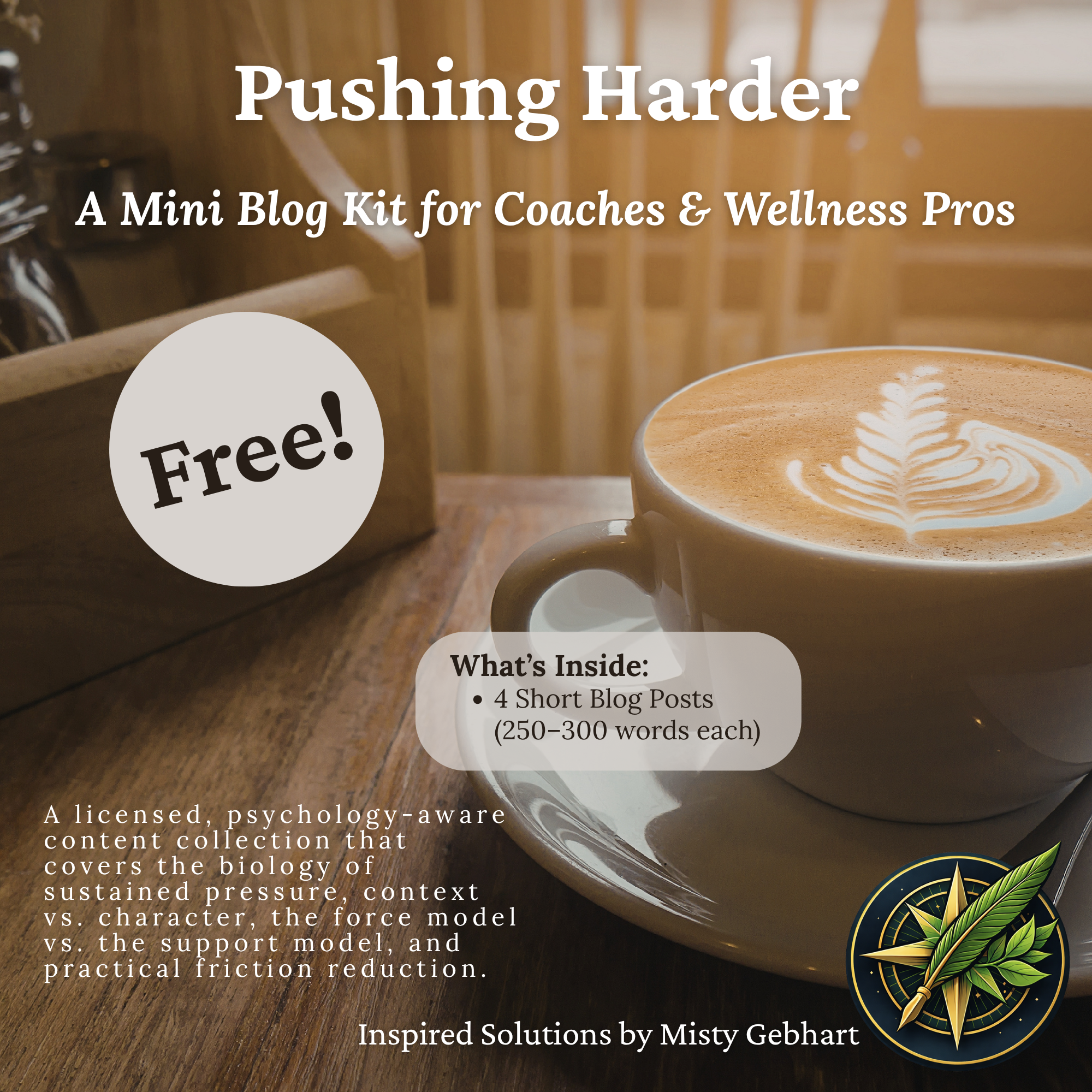
Pushing Harder - Mini Blog Set
Give your audience a different answer to everyday exhaustion than “try harder.”
Not every kind of tired is solved by more sleep.
Not every frustrating part of the day requires better discipline.
Not every open minute needs to be filled.
And being capable doesn't mean doing everything without support.
Pushing Harder takes a closer look at the small, ordinary ways effort becomes more expensive than it needs to be.
This free four-part Mini Blog Set gives you ready-to-share, human-centered wellness education that helps your audience recognize mental load, recurring friction, missing transition time, and the unnecessary pressure to handle everything alone.
Four short wellness articles. Ready to share. Completely free.
The Pushing Harder Mini Blog Set is a collection of four short, ready-to-share wellness articles for businesses, employers, wellness professionals, and organizations that want practical content around energy and capacity without turning wellbeing into another productivity assignment.
Each article looks at one everyday source of strain and offers a simple shift in perspective — not an overhaul, challenge, or new routine to maintain.
Publish them throughout the month or use them individually whenever the topic fits your audience.
What's inside
4 short, ready-to-share wellness articles
One cohesive wellness theme
Practical, human-centered education
Licensed use with your own audience
Permission to publish across multiple approved channels
Indefinite use when the license terms are followed
$0 cost
Use them on your website or blog, in email newsletters, employee wellness communications, internal employee platforms, social media, or communications to your patients, clients, customers, or members.
Free — $0
No subscription. No trial period. No future payment required to keep using content you've legitimately obtained.
Download the set, follow the included Free Content License, and share the articles with your own audience.
As long as the license terms are followed, content legitimately obtained through the Free Content program may continue to be used indefinitely.
The Mini Blog Series
Tired Doesn't Always Mean You Need More Sleep
Explores the kind of exhaustion that can come from spending too much time mentally on.
Remembering. Deciding. Switching tasks. Responding to messages. Tracking other people's needs. Watching the clock. Thinking about work after work has technically ended.
None of those things may look particularly exhausting on its own. Together, they can create a steady background demand on attention.
This article distinguishes sleep from other forms of mental recovery and gives readers a useful question to consider when they're getting reasonable sleep but still feel depleted:
When does my brain actually get to be off duty?
The answer may reveal a need that simply going to bed earlier won't address.
Small Friction Can Create Big Fatigue
Uses the wonderfully ordinary example of a sticky drawer to show how small inconveniences can become surprisingly expensive when they're repeated often enough.
The forgotten password. Constant notifications. Supplies stored somewhere inconvenient. The same unclear conversation. The morning scramble caused by something never being where it's needed.
Individually, they're minor.
Repeatedly, they cost energy.
Rather than responding by trying to become more organized, disciplined, or efficient, this article introduces a simpler possibility:
Fix the sticky drawer.
Readers are encouraged to identify one recurring source of unnecessary friction and ask whether it could simply be made easier. Supporting yourself doesn't always require adding a new habit. Sometimes it means making something you're already doing require less effort.
Transition Time Counts
Looks at what happens when one demand technically ends but the next begins immediately.
One meeting ends as another starts. Work finishes and dinner, errands, questions, caregiving, or evening responsibilities immediately take its place.
There may have been a transition on the calendar.
The body may disagree.
This article shows why even tiny buffers — two minutes after a difficult phone call, five minutes between work and home, a bathroom break, stretching, getting a drink, or simply looking out the window — can give the system an opportunity to register that one thing has ended before another begins.
Transition time isn't wasted time.
A few minutes of nothing productive happening may be helping someone arrive at what's next instead of simply crashing into it.
Needing Help Doesn't Cancel Out Capability
Challenges a belief that can be particularly stubborn for dependable people:
If I'm capable of doing it, I should be able to handle it myself.
But I can do this and I should have to do all of this alone are very different statements.
This article separates capability from obligation and gives readers practical examples of what support can look like: sharing one task, asking for clarification, renegotiating an unrealistic deadline, or simply admitting that something is harder than expected.
None of those things erases competence.
The article offers a particularly useful comparison: we don't question whether bridges are strong because they have supports underneath them. The support is part of what allows them to carry the load.
People aren't so different.
Why offer Inspired Chapter content to your audience?
Wellness advice often adds something else for people to do.
These Mini Blogs do something different.
They help readers look at the effort they're already making and notice where ordinary life may be costing more energy than necessary.
They're short enough to read without becoming another assignment and substantial enough to leave your audience with a useful idea they can carry into the rest of their day.
And because they're already written and licensed for your direct audience, you can focus on sharing the conversation instead of creating it.
Publish it inside your own branded channels
Your website can still look like your website. Your newsletter can still look like your newsletter. Your social channels can still look like your business.
Ordinary visual formatting is permitted, and the Mini Blogs can appear within your normally branded environment.
The articles themselves remain Inspired Chapter content and must be published intact, including the supplied attribution and Inspired Chapter call to action.
Each article includes:
Written by Misty Gebhart | Inspired Chapter
More practical, human-centered wellness education from Inspired Chapter.
Those elements stay with the article when you publish it.
Want to go deeper?
The Mini Blog Set gives your audience an approachable introduction to the Pushing Harder conversation.
When you want more substantial content around the same theme, Inspired Chapter offers two licensed options:
The Themed Blog Set — $150
Four full-length wellness articles exploring why pushing harder stops working, how systems and environments affect capacity, what sustainable effort feels like, and why support doesn't diminish capability.
The Month-in-a-Box — $249
The complete Pushing Harder content system, including the long-form "When Pushing Harder Isn't the Answer" anchor article, four supporting blogs, a 28-day content planner, light assets, and the Reduce the Friction practical guide.
Start with what you need. Go deeper when it makes sense.
Who this is for
Wellness businesses that want approachable content around energy, capacity, and everyday strain
HR and People Operations teams looking for employee wellbeing education without another productivity campaign
Healthcare and wellness professionals who want practical content for their audiences
Small businesses without dedicated wellness content teams
Organizations that want to support sustainable effort without reinforcing hustle culture
Who this is not for
Anyone looking for white-label content
Anyone looking for content they can rewrite, repurpose, excerpt, or claim as their own
Businesses looking for content to resell or redistribute to other organizations
Anyone looking for clinical, therapeutic, medical, legal, financial, or individualized professional advice
A quick note about the Free Content License
Free doesn't mean public domain.
Your download gives you permission to publish and share these Mini Blogs with your own audience. The content must remain intact, including the supplied Inspired Chapter attribution and CTA, and cannot be rewritten, adapted, excerpted, resold, sublicensed, or transferred to another business or organization.
Each business or organization that wants to use the content must obtain its own copy directly from Inspired Chapter and agree to the Free Content License.
All content remains the intellectual property of Inspired Chapter and/or Misty Gebhart and is provided under license. © 2026 Inspired Chapter. All Rights Reserved.
Give your audience a different answer to everyday exhaustion than “try harder.”
Not every kind of tired is solved by more sleep.
Not every frustrating part of the day requires better discipline.
Not every open minute needs to be filled.
And being capable doesn't mean doing everything without support.
Pushing Harder takes a closer look at the small, ordinary ways effort becomes more expensive than it needs to be.
This free four-part Mini Blog Set gives you ready-to-share, human-centered wellness education that helps your audience recognize mental load, recurring friction, missing transition time, and the unnecessary pressure to handle everything alone.
Four short wellness articles. Ready to share. Completely free.
The Pushing Harder Mini Blog Set is a collection of four short, ready-to-share wellness articles for businesses, employers, wellness professionals, and organizations that want practical content around energy and capacity without turning wellbeing into another productivity assignment.
Each article looks at one everyday source of strain and offers a simple shift in perspective — not an overhaul, challenge, or new routine to maintain.
Publish them throughout the month or use them individually whenever the topic fits your audience.
What's inside
4 short, ready-to-share wellness articles
One cohesive wellness theme
Practical, human-centered education
Licensed use with your own audience
Permission to publish across multiple approved channels
Indefinite use when the license terms are followed
$0 cost
Use them on your website or blog, in email newsletters, employee wellness communications, internal employee platforms, social media, or communications to your patients, clients, customers, or members.
Free — $0
No subscription. No trial period. No future payment required to keep using content you've legitimately obtained.
Download the set, follow the included Free Content License, and share the articles with your own audience.
As long as the license terms are followed, content legitimately obtained through the Free Content program may continue to be used indefinitely.
The Mini Blog Series
Tired Doesn't Always Mean You Need More Sleep
Explores the kind of exhaustion that can come from spending too much time mentally on.
Remembering. Deciding. Switching tasks. Responding to messages. Tracking other people's needs. Watching the clock. Thinking about work after work has technically ended.
None of those things may look particularly exhausting on its own. Together, they can create a steady background demand on attention.
This article distinguishes sleep from other forms of mental recovery and gives readers a useful question to consider when they're getting reasonable sleep but still feel depleted:
When does my brain actually get to be off duty?
The answer may reveal a need that simply going to bed earlier won't address.
Small Friction Can Create Big Fatigue
Uses the wonderfully ordinary example of a sticky drawer to show how small inconveniences can become surprisingly expensive when they're repeated often enough.
The forgotten password. Constant notifications. Supplies stored somewhere inconvenient. The same unclear conversation. The morning scramble caused by something never being where it's needed.
Individually, they're minor.
Repeatedly, they cost energy.
Rather than responding by trying to become more organized, disciplined, or efficient, this article introduces a simpler possibility:
Fix the sticky drawer.
Readers are encouraged to identify one recurring source of unnecessary friction and ask whether it could simply be made easier. Supporting yourself doesn't always require adding a new habit. Sometimes it means making something you're already doing require less effort.
Transition Time Counts
Looks at what happens when one demand technically ends but the next begins immediately.
One meeting ends as another starts. Work finishes and dinner, errands, questions, caregiving, or evening responsibilities immediately take its place.
There may have been a transition on the calendar.
The body may disagree.
This article shows why even tiny buffers — two minutes after a difficult phone call, five minutes between work and home, a bathroom break, stretching, getting a drink, or simply looking out the window — can give the system an opportunity to register that one thing has ended before another begins.
Transition time isn't wasted time.
A few minutes of nothing productive happening may be helping someone arrive at what's next instead of simply crashing into it.
Needing Help Doesn't Cancel Out Capability
Challenges a belief that can be particularly stubborn for dependable people:
If I'm capable of doing it, I should be able to handle it myself.
But I can do this and I should have to do all of this alone are very different statements.
This article separates capability from obligation and gives readers practical examples of what support can look like: sharing one task, asking for clarification, renegotiating an unrealistic deadline, or simply admitting that something is harder than expected.
None of those things erases competence.
The article offers a particularly useful comparison: we don't question whether bridges are strong because they have supports underneath them. The support is part of what allows them to carry the load.
People aren't so different.
Why offer Inspired Chapter content to your audience?
Wellness advice often adds something else for people to do.
These Mini Blogs do something different.
They help readers look at the effort they're already making and notice where ordinary life may be costing more energy than necessary.
They're short enough to read without becoming another assignment and substantial enough to leave your audience with a useful idea they can carry into the rest of their day.
And because they're already written and licensed for your direct audience, you can focus on sharing the conversation instead of creating it.
Publish it inside your own branded channels
Your website can still look like your website. Your newsletter can still look like your newsletter. Your social channels can still look like your business.
Ordinary visual formatting is permitted, and the Mini Blogs can appear within your normally branded environment.
The articles themselves remain Inspired Chapter content and must be published intact, including the supplied attribution and Inspired Chapter call to action.
Each article includes:
Written by Misty Gebhart | Inspired Chapter
More practical, human-centered wellness education from Inspired Chapter.
Those elements stay with the article when you publish it.
Want to go deeper?
The Mini Blog Set gives your audience an approachable introduction to the Pushing Harder conversation.
When you want more substantial content around the same theme, Inspired Chapter offers two licensed options:
The Themed Blog Set — $150
Four full-length wellness articles exploring why pushing harder stops working, how systems and environments affect capacity, what sustainable effort feels like, and why support doesn't diminish capability.
The Month-in-a-Box — $249
The complete Pushing Harder content system, including the long-form "When Pushing Harder Isn't the Answer" anchor article, four supporting blogs, a 28-day content planner, light assets, and the Reduce the Friction practical guide.
Start with what you need. Go deeper when it makes sense.
Who this is for
Wellness businesses that want approachable content around energy, capacity, and everyday strain
HR and People Operations teams looking for employee wellbeing education without another productivity campaign
Healthcare and wellness professionals who want practical content for their audiences
Small businesses without dedicated wellness content teams
Organizations that want to support sustainable effort without reinforcing hustle culture
Who this is not for
Anyone looking for white-label content
Anyone looking for content they can rewrite, repurpose, excerpt, or claim as their own
Businesses looking for content to resell or redistribute to other organizations
Anyone looking for clinical, therapeutic, medical, legal, financial, or individualized professional advice
A quick note about the Free Content License
Free doesn't mean public domain.
Your download gives you permission to publish and share these Mini Blogs with your own audience. The content must remain intact, including the supplied Inspired Chapter attribution and CTA, and cannot be rewritten, adapted, excerpted, resold, sublicensed, or transferred to another business or organization.
Each business or organization that wants to use the content must obtain its own copy directly from Inspired Chapter and agree to the Free Content License.
All content remains the intellectual property of Inspired Chapter and/or Misty Gebhart and is provided under license. © 2026 Inspired Chapter. All Rights Reserved.