
 Image 1 of 2
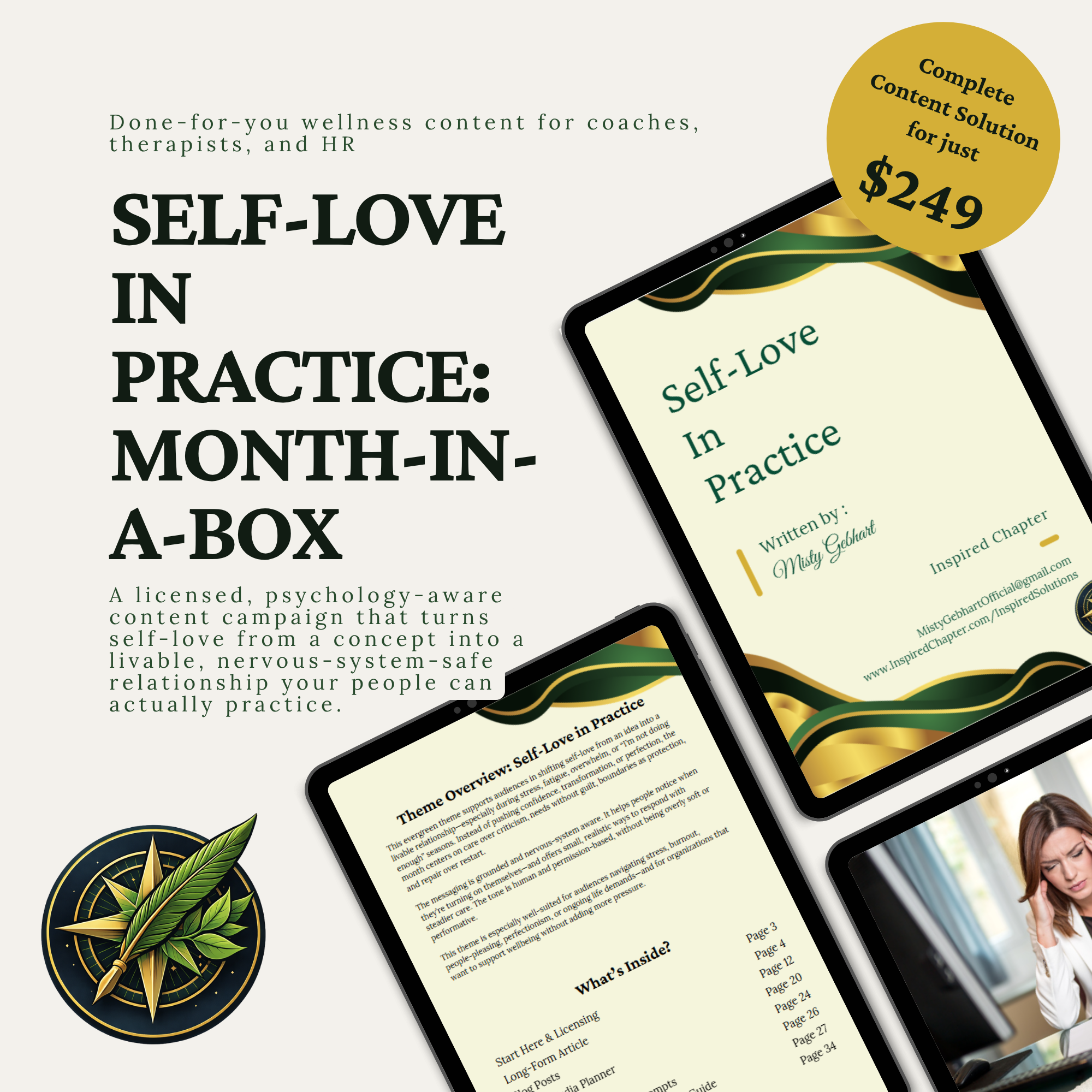 Image 2 of 2
Self-Love in Practice
Self-Love in Practice — Month-in-a-Box
Self-love is easy to talk about. Practicing it when life is messy is something else entirely.
Wellness messaging often focuses on what people should do—move more, sleep better, manage stress, set boundaries, take care of themselves.
But underneath all of that is another conversation:
How do people actually treat themselves while they're trying to do those things?
The constant inner pressure. The guilt around meeting basic needs. The difficulty setting a boundary without feeling selfish. The belief that rest, care, or worthiness has to be earned.
Self-Love in Practice brings the conversation down from the abstract and into everyday life—exploring what self-love actually looks like when it becomes something we practice rather than something we simply believe in.
A complete month of wellness content — already done.
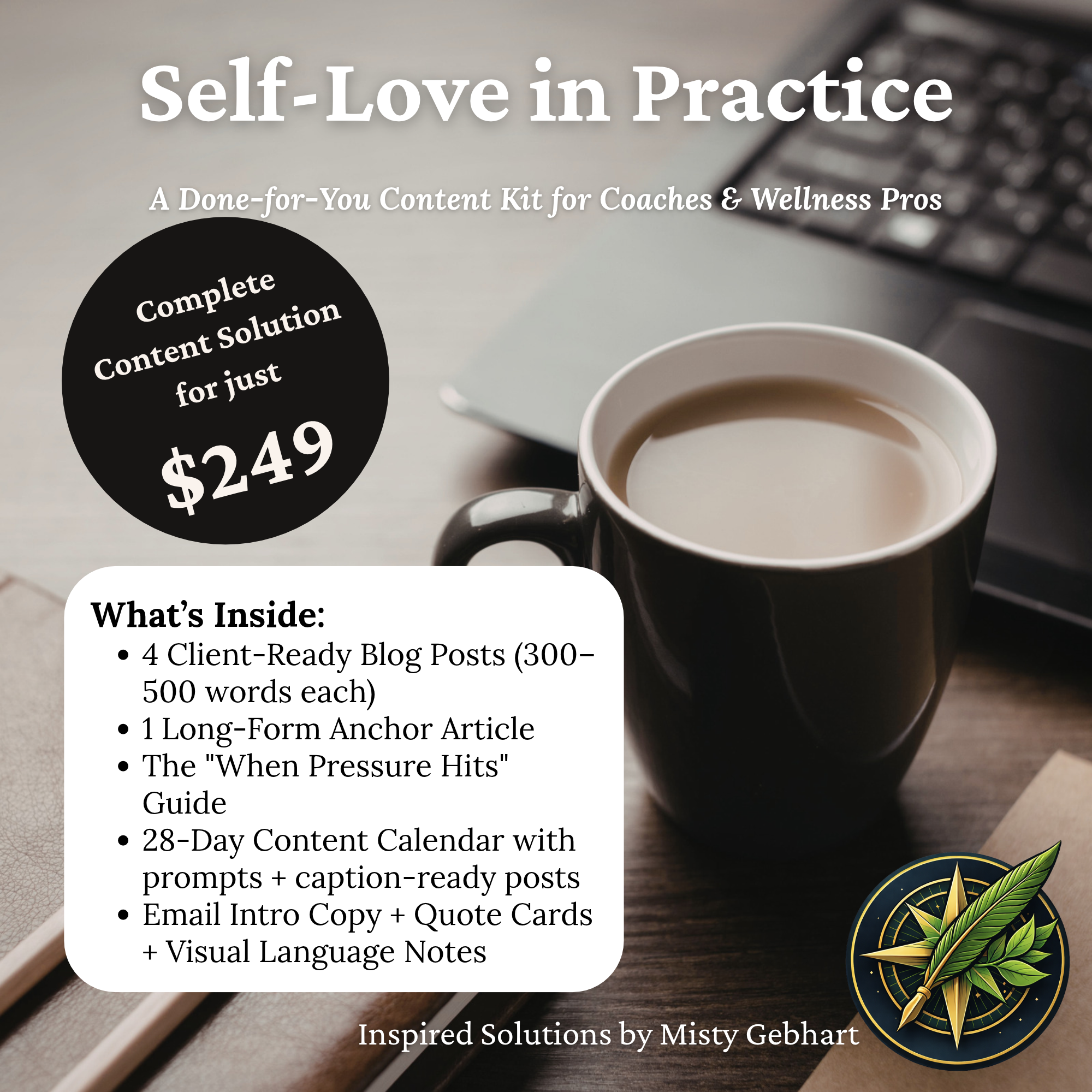
Self-Love in Practice is a licensed, ready-to-use content system for wellness professionals and businesses that want to offer thoughtful, psychology-aware content without having to research, write, and plan it all themselves.
This theme explores self-criticism, needs, boundaries, worthiness, repair, and the small repeated acts of care that help people build a more supportive relationship with themselves.
What's inside
1 anchor article (2,500+ words) — Self-Love in Practice: What Care Looks Like When Life Is Messy
4 supporting blog posts (800–1,200 words each) — ready to publish or lightly adapt
28-day content and social media planner — daily prompts organized by weekly theme, with post type and description
Light assets — 5 quotes, 2 caption-ready posts, closing lines, visual direction notes, and 6 writing hooks
1 client-facing guided journal — When Pressure Hits
Clear professional-use licensing — use and lightly adapt the content with your own audience, under your own brand and voice, within the terms of the license
$249 — one-time purchase
No subscription. No recurring charge. No required purchase schedule.
One purchase gives you the complete Self-Love in Practice Month-in-a-Box and its professional-use license.
Choose it because the theme fits your work and your audience. Put the content to work in the channels and services you already use.
A closer look at what you're getting
The anchor article
Self-Love in Practice: What Care Looks Like When Life Is Messy explores why self-criticism can feel productive while keeping the nervous system braced, how care can signal safety more effectively than constant pressure, why meeting basic needs without guilt helps rebuild self-trust, and how boundaries can function as protection rather than withdrawal.
It explores the biology of inner pressure, needs as signals, repair over perfection, and how small repeated acts of care can create meaningful change.
Use it as a blog or newsletter feature, educational resource, discussion starter, workshop foundation, membership resource, or wherever longer-form education fits naturally into your work.
The blog series
Love as Care, Not Criticism
Names the familiar pattern of self-pressure and introduces care as a steadier alternative to constant internal criticism.
Loving Yourself Means Meeting Your Needs
Explores why basic needs are so often ignored under sustained demand and how responding to those needs can rebuild trust and reduce resentment.
Boundaries Are a Form of Self-Love
Reframes boundaries as containers that protect energy and capacity rather than walls that push people away.
Choosing Yourself, Again and Again
Normalizes imperfect practice, positions repair as more important than perfection, and addresses the all-or-nothing thinking that can derail self-care.
The 28-day content and social media planner
Four weeks of daily content organized around the theme:
Week 1: When Pressure Shows Up
Recognizing internal pressure patterns without immediately trying to fix them.
Week 2: Care Over Commentary
Exploring what changes when criticism is replaced with steadier, more supportive responses.
Week 3: Needs & Boundaries Count
Making room for responsiveness instead of treating endurance as the goal.
Week 4: Repair as the Practice
Returning to care without requiring perfection.
Each day gives you direction for continuing the conversation with your audience, so you aren't staring at a blank screen wondering what to say next.
Use the planner to support social media, newsletters, client or member communications, educational content, or other audience-facing channels that fit your business.
The client-facing guided journal
When Pressure Hits is a formatted PDF designed to be shared directly with your audience.
It includes a simple, practical process for noticing when pressure turns into self-criticism, shifting from criticism toward care, identifying what care could look like in the moment, and returning to care when you don't respond perfectly.
No therapy language. No pressure.
Just honest, grounded support people can use when life feels difficult, frustrating, or overwhelming.
Why this conversation matters
Self-love can easily become another wellness concept people understand intellectually but struggle to practice when they actually need it.
When pressure is high, needs are often pushed aside. Boundaries become harder to hold. Rest can feel undeserved. Self-criticism gets mistaken for motivation.
Self-Love in Practice gives you a way to take the conversation deeper.
Content that helps your audience:
Recognize when self-criticism is masquerading as motivation
Respond to basic needs without requiring guilt or justification
Understand boundaries as a way to protect energy and capacity
Practice care without needing to earn it first
Return to themselves after setbacks rather than treating imperfection as failure
It moves self-love away from slogans and toward the ordinary decisions that shape how people actually live with themselves.
Who this is for
Month-in-a-Box is designed for wellness professionals and businesses that regularly educate, support, or communicate with an audience around wellbeing.
That might include:
Wellness coaches and educators
Spas and massage practices
Chiropractors
Fitness and movement professionals
Holistic wellness businesses
Wellness consultants
Membership communities
Other wellness-focused professionals and organizations that need thoughtful content for the people they serve
You don't need a dedicated content team.
You just need an audience you want to serve well.
Who this is not for
This Month-in-a-Box is not intended for:
Anyone looking for clinical, diagnostic, or therapeutic content
Businesses looking for fully customized content written specifically for their brand or audience
Anyone looking to resell, redistribute, or sublicense the original content to other professionals or businesses
Anyone looking for PLR, resale-rights content, or content they can claim original copyright ownership of
Professional-Use License
Your purchase includes a non-exclusive, non-transferable professional-use license.
You may use and lightly edit the content with your own audience, present it under your own brand and voice, and incorporate it into your programs, workshops, memberships, communications, and similar services within the terms of the license.
The purchase licenses the content for professional use. It does not transfer ownership of the underlying intellectual property.
All content remains the intellectual property of Inspired Chapter / Inspired Solutions (Misty Gebhart).
© 2026 Inspired Chapter / Inspired Solutions. All Rights Reserved. Licensed, not sold.
Self-Love in Practice — Month-in-a-Box
Self-love is easy to talk about. Practicing it when life is messy is something else entirely.
Wellness messaging often focuses on what people should do—move more, sleep better, manage stress, set boundaries, take care of themselves.
But underneath all of that is another conversation:
How do people actually treat themselves while they're trying to do those things?
The constant inner pressure. The guilt around meeting basic needs. The difficulty setting a boundary without feeling selfish. The belief that rest, care, or worthiness has to be earned.
Self-Love in Practice brings the conversation down from the abstract and into everyday life—exploring what self-love actually looks like when it becomes something we practice rather than something we simply believe in.
A complete month of wellness content — already done.
Self-Love in Practice is a licensed, ready-to-use content system for wellness professionals and businesses that want to offer thoughtful, psychology-aware content without having to research, write, and plan it all themselves.
This theme explores self-criticism, needs, boundaries, worthiness, repair, and the small repeated acts of care that help people build a more supportive relationship with themselves.
What's inside
1 anchor article (2,500+ words) — Self-Love in Practice: What Care Looks Like When Life Is Messy
4 supporting blog posts (800–1,200 words each) — ready to publish or lightly adapt
28-day content and social media planner — daily prompts organized by weekly theme, with post type and description
Light assets — 5 quotes, 2 caption-ready posts, closing lines, visual direction notes, and 6 writing hooks
1 client-facing guided journal — When Pressure Hits
Clear professional-use licensing — use and lightly adapt the content with your own audience, under your own brand and voice, within the terms of the license
$249 — one-time purchase
No subscription. No recurring charge. No required purchase schedule.
One purchase gives you the complete Self-Love in Practice Month-in-a-Box and its professional-use license.
Choose it because the theme fits your work and your audience. Put the content to work in the channels and services you already use.
A closer look at what you're getting
The anchor article
Self-Love in Practice: What Care Looks Like When Life Is Messy explores why self-criticism can feel productive while keeping the nervous system braced, how care can signal safety more effectively than constant pressure, why meeting basic needs without guilt helps rebuild self-trust, and how boundaries can function as protection rather than withdrawal.
It explores the biology of inner pressure, needs as signals, repair over perfection, and how small repeated acts of care can create meaningful change.
Use it as a blog or newsletter feature, educational resource, discussion starter, workshop foundation, membership resource, or wherever longer-form education fits naturally into your work.
The blog series
Love as Care, Not Criticism
Names the familiar pattern of self-pressure and introduces care as a steadier alternative to constant internal criticism.
Loving Yourself Means Meeting Your Needs
Explores why basic needs are so often ignored under sustained demand and how responding to those needs can rebuild trust and reduce resentment.
Boundaries Are a Form of Self-Love
Reframes boundaries as containers that protect energy and capacity rather than walls that push people away.
Choosing Yourself, Again and Again
Normalizes imperfect practice, positions repair as more important than perfection, and addresses the all-or-nothing thinking that can derail self-care.
The 28-day content and social media planner
Four weeks of daily content organized around the theme:
Week 1: When Pressure Shows Up
Recognizing internal pressure patterns without immediately trying to fix them.
Week 2: Care Over Commentary
Exploring what changes when criticism is replaced with steadier, more supportive responses.
Week 3: Needs & Boundaries Count
Making room for responsiveness instead of treating endurance as the goal.
Week 4: Repair as the Practice
Returning to care without requiring perfection.
Each day gives you direction for continuing the conversation with your audience, so you aren't staring at a blank screen wondering what to say next.
Use the planner to support social media, newsletters, client or member communications, educational content, or other audience-facing channels that fit your business.
The client-facing guided journal
When Pressure Hits is a formatted PDF designed to be shared directly with your audience.
It includes a simple, practical process for noticing when pressure turns into self-criticism, shifting from criticism toward care, identifying what care could look like in the moment, and returning to care when you don't respond perfectly.
No therapy language. No pressure.
Just honest, grounded support people can use when life feels difficult, frustrating, or overwhelming.
Why this conversation matters
Self-love can easily become another wellness concept people understand intellectually but struggle to practice when they actually need it.
When pressure is high, needs are often pushed aside. Boundaries become harder to hold. Rest can feel undeserved. Self-criticism gets mistaken for motivation.
Self-Love in Practice gives you a way to take the conversation deeper.
Content that helps your audience:
Recognize when self-criticism is masquerading as motivation
Respond to basic needs without requiring guilt or justification
Understand boundaries as a way to protect energy and capacity
Practice care without needing to earn it first
Return to themselves after setbacks rather than treating imperfection as failure
It moves self-love away from slogans and toward the ordinary decisions that shape how people actually live with themselves.
Who this is for
Month-in-a-Box is designed for wellness professionals and businesses that regularly educate, support, or communicate with an audience around wellbeing.
That might include:
Wellness coaches and educators
Spas and massage practices
Chiropractors
Fitness and movement professionals
Holistic wellness businesses
Wellness consultants
Membership communities
Other wellness-focused professionals and organizations that need thoughtful content for the people they serve
You don't need a dedicated content team.
You just need an audience you want to serve well.
Who this is not for
This Month-in-a-Box is not intended for:
Anyone looking for clinical, diagnostic, or therapeutic content
Businesses looking for fully customized content written specifically for their brand or audience
Anyone looking to resell, redistribute, or sublicense the original content to other professionals or businesses
Anyone looking for PLR, resale-rights content, or content they can claim original copyright ownership of
Professional-Use License
Your purchase includes a non-exclusive, non-transferable professional-use license.
You may use and lightly edit the content with your own audience, present it under your own brand and voice, and incorporate it into your programs, workshops, memberships, communications, and similar services within the terms of the license.
The purchase licenses the content for professional use. It does not transfer ownership of the underlying intellectual property.
All content remains the intellectual property of Inspired Chapter / Inspired Solutions (Misty Gebhart).
© 2026 Inspired Chapter / Inspired Solutions. All Rights Reserved. Licensed, not sold.