
 Image 1 of 1
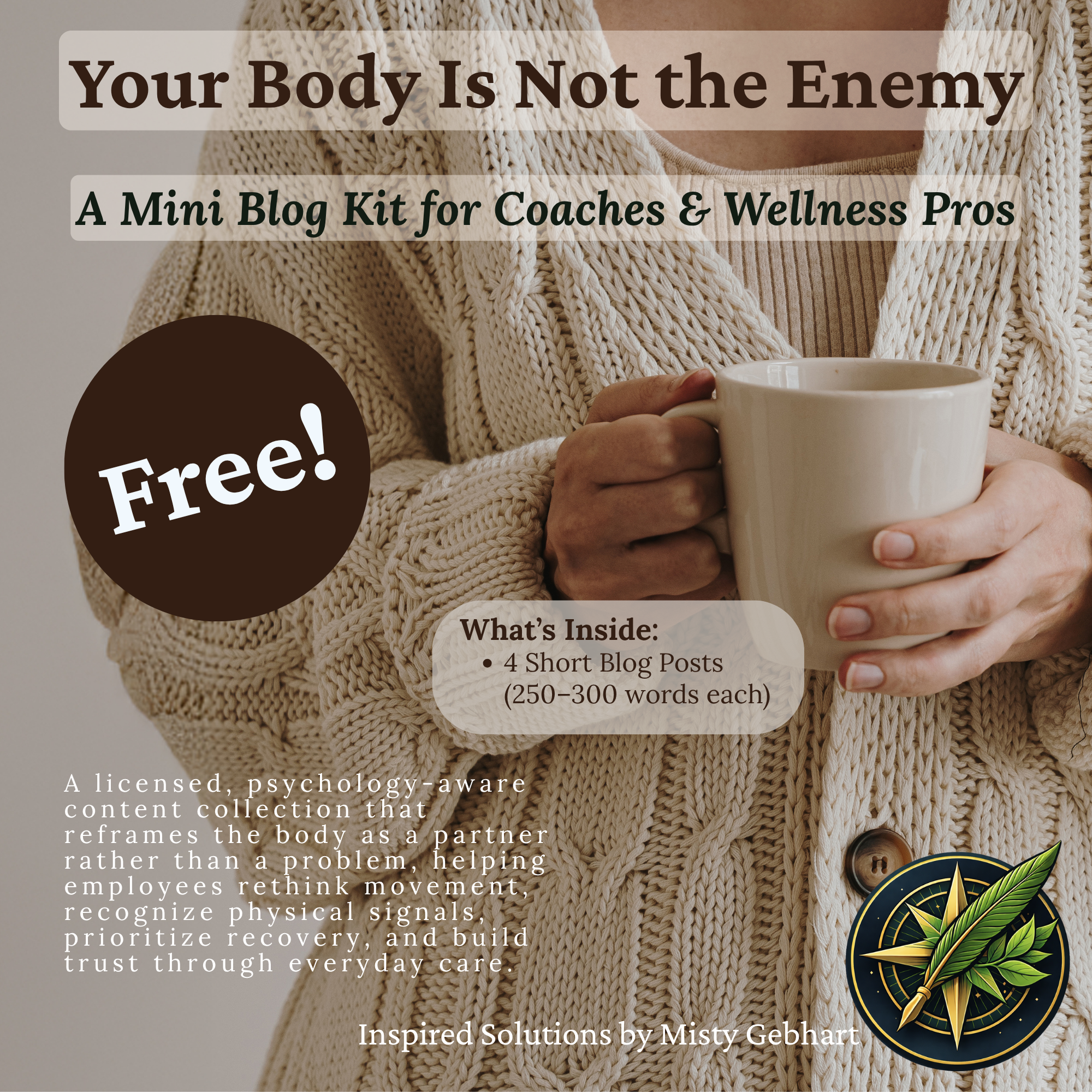
Your Body Is Not the Enemy - Mini Blog Set
Give your audience a gentler way to think about the body they live in every day.
We can be surprisingly hard on our bodies.
We dismiss movement because it didn't happen at the gym. Choose the activity we're supposed to do instead of the one we actually enjoy. Ignore hunger, tension, fatigue, or stiffness until those signals become difficult to overlook.
And when the body needs something at an inconvenient time, it's easy to treat the need itself as the problem.
Your Body Is Not the Enemy offers another perspective.
This free four-part Mini Blog Set gives you short, ready-to-share wellness articles that help your audience see movement, physical signals, and everyday needs through the lens of partnership instead of criticism.
Four short wellness articles. Ready to share. Completely free.
The Your Body Is Not the Enemy Mini Blog Set was created for businesses, employers, wellness professionals, and organizations that want approachable, human-centered wellness content for their audiences without creating it themselves.
Each article explores one everyday way people can begin relating differently to their bodies — without prescribing a workout plan, promoting weight loss, or suggesting they need to become more disciplined.
Publish the articles throughout the month or use them individually whenever the conversation fits your audience.
What's inside
4 short, ready-to-share wellness articles
One cohesive wellness theme
Practical, human-centered education
Licensed use with your own audience
Permission to publish across multiple approved channels
Indefinite use when the license terms are followed
$0 cost
Use them on your website or blog, in email newsletters, employee wellness communications, internal employee platforms, social media, or communications to your patients, clients, customers, or members.
Free — $0
No subscription. No trial period. No future payment required to keep using content you've legitimately obtained.
Download the set, follow the included Free Content License, and share the articles with your own audience.
As long as the license terms are followed, content legitimately obtained through the Free Content program may continue to be used indefinitely.
The Mini Blog Series
Your Body Doesn't Know Whether It "Counts"
Starts with an odd little contradiction many people will recognize immediately.
You walk through the neighborhood.
Spend an afternoon gardening.
Dance while making dinner.
Walk through a museum for two hours.
Then someone asks whether you exercised, and you say no.
We've created very specific rules about which kinds of movement count — usually involving workout clothes, intentional exercise, enough time, or enough intensity to feel official.
The body doesn't know those rules.
Muscles still participate when you carry groceries. Joints still move when you're gardening. A walk still involves your body whether you're tracking your pace or looking in shop windows.
This article doesn't dismiss structured exercise. It simply widens the definition of movement — especially for people who may have spent years believing they're "bad at exercise."
Instead of asking Did I exercise?, readers are invited to try another question:
How did my body move today?
The answer may reveal that they're already moving more than they give themselves credit for.
Enjoyment Is Useful Information
Challenges the assumption that the most effective wellness choice must also be the one that requires the most discipline.
We're accustomed to asking which activity burns the most calories, builds the most strength, produces the fastest result, or is considered the "best."
Whether we actually like doing it can seem almost irrelevant.
But enjoyment provides useful information:
You might come back.
Someone may happily spend hours gardening but dread a thirty-minute workout. Walk farther while exploring a new town than they ever would on a treadmill. Dance, swim, hike, bowl, play with their children, or wander through a flea market without needing to negotiate with themselves first.
That matters.
Not everything that supports us will be enjoyable every time. But wellness doesn't have to be built entirely from things we force ourselves to tolerate.
Instead of only asking What should I be doing?, this article invites readers to consider:
What kind of movement do I actually enjoy enough to want to do again?
Because enjoyment doesn't make movement less valuable.
Sometimes it makes it more sustainable.
Your Body Usually Whispers Before It Shouts
Brings attention to the small physical signals that are remarkably easy to postpone.
A little stiffness.
A dry mouth.
Hunger beginning to build.
Shoulders creeping upward.
Tired eyes after hours at a screen.
Fatigue quietly suggesting that enough may be enough for today.
Most body signals don't begin dramatically.
They begin small.
And real life means we can't always respond perfectly the instant a need appears. But when postponing becomes the default, the message often gets louder.
Mild hunger becomes ravenous hunger. Tension becomes a headache. Tiredness becomes exhaustion. Stiffness becomes discomfort that's much harder to ignore.
This article isn't an invitation to monitor every sensation.
It's an invitation to become interested in the earlier messages and occasionally ask:
What is my body telling me right now?
Sometimes the answer will require action. Sometimes nothing needs to change.
Either way, the body's quieter signals are worth hearing before they have to shout.
Your Body Is Not an Inconvenience
Addresses an experience almost everyone knows:
The body needing something at exactly the wrong time.
You're tired, but there's more to do.
You're hungry in the middle of something important.
Something hurts on the day you had plans.
You need a break when the calendar has absolutely no room for one.
It can be frustrating.
And without realizing it, frustration with the timing can become frustration with the body itself.
Why can't I just keep going? Why does my body always need something?
This article offers a simple reframe:
Needing things isn't evidence that your body is failing. It's evidence that you have a body.
Bodies require nourishment, hydration, movement, sleep, recovery, medical care, and ordinary maintenance because they're alive.
We won't always be able to respond to every need exactly when it appears. That's real life.
But we can begin changing how we interpret the request.
Fatigue isn't betrayal.
Hunger isn't bad timing.
Recovery isn't laziness.
Your body isn't interrupting your life.
Your body is the reason you get to participate in it.
Why offer Inspired Chapter content to your audience?
Wellness content about the body can become prescriptive very quickly.
Do this exercise. Follow this routine. Hit this target. Change this number.
These Mini Blogs do something different.
They give your audience small, approachable ways to reconsider the relationship they already have with their bodies — through movement, enjoyment, awareness, and everyday needs.
They're short enough to be accessible and substantial enough to create a meaningful shift in perspective.
And because they're already written and licensed for your direct audience, you can focus on sharing the conversation instead of creating it.
Publish it inside your own branded channels
Your website can still look like your website. Your newsletter can still look like your newsletter. Your social channels can still look like your business.
Ordinary visual formatting is permitted, and the Mini Blogs can appear within your normally branded environment.
The articles themselves remain Inspired Chapter content and must be published intact, including the supplied attribution and Inspired Chapter call to action.
Each article includes:
Written by Misty Gebhart | Inspired Chapter
More practical, human-centered wellness education from Inspired Chapter.
Those elements stay with the article when you publish it.
Want to go deeper?
The Mini Blog Set gives your audience an approachable introduction to the Your Body Is Not the Enemy conversation.
When you want more substantial content around the same theme, Inspired Chapter offers two licensed options:
The Themed Blog Set — $150
Four full-length wellness articles exploring everyday movement, enjoyable movement, body feedback, and recovery as part of sustainable progress.
The Month-in-a-Box — $249
The complete Your Body Is Not the Enemy content system, including the long-form anchor article, four supporting blogs, a 28-day content planner, light assets, and the Finding Movement That Feels Supportive guide.
Start with what you need. Go deeper when it makes sense.
Who this is for
Wellness businesses that want approachable, body-aware education for their audiences
HR and People Operations teams looking for inclusive physical-wellness content
Healthcare and wellness professionals who want practical content around movement, body awareness, and everyday care
Small businesses without dedicated wellness content teams
Organizations that want to support wellbeing without weight-loss messaging, fitness pressure, or body criticism
Who this is not for
Anyone looking for white-label content
Anyone looking for content they can rewrite, repurpose, excerpt, or claim as their own
Businesses looking for content to resell or redistribute to other organizations
Anyone looking for clinical, therapeutic, medical, fitness, or individualized professional advice
A quick note about the Free Content License
Free doesn't mean public domain.
Your download gives you permission to publish and share these Mini Blogs with your own audience. The content must remain intact, including the supplied Inspired Chapter attribution and CTA, and cannot be rewritten, adapted, excerpted, resold, sublicensed, or transferred to another business or organization.
Each business or organization that wants to use the content must obtain its own copy directly from Inspired Chapter and agree to the Free Content License.
All content remains the intellectual property of Inspired Chapter and/or Misty Gebhart and is provided under license. © 2026 Inspired Chapter. All Rights Reserved.
Give your audience a gentler way to think about the body they live in every day.
We can be surprisingly hard on our bodies.
We dismiss movement because it didn't happen at the gym. Choose the activity we're supposed to do instead of the one we actually enjoy. Ignore hunger, tension, fatigue, or stiffness until those signals become difficult to overlook.
And when the body needs something at an inconvenient time, it's easy to treat the need itself as the problem.
Your Body Is Not the Enemy offers another perspective.
This free four-part Mini Blog Set gives you short, ready-to-share wellness articles that help your audience see movement, physical signals, and everyday needs through the lens of partnership instead of criticism.
Four short wellness articles. Ready to share. Completely free.
The Your Body Is Not the Enemy Mini Blog Set was created for businesses, employers, wellness professionals, and organizations that want approachable, human-centered wellness content for their audiences without creating it themselves.
Each article explores one everyday way people can begin relating differently to their bodies — without prescribing a workout plan, promoting weight loss, or suggesting they need to become more disciplined.
Publish the articles throughout the month or use them individually whenever the conversation fits your audience.
What's inside
4 short, ready-to-share wellness articles
One cohesive wellness theme
Practical, human-centered education
Licensed use with your own audience
Permission to publish across multiple approved channels
Indefinite use when the license terms are followed
$0 cost
Use them on your website or blog, in email newsletters, employee wellness communications, internal employee platforms, social media, or communications to your patients, clients, customers, or members.
Free — $0
No subscription. No trial period. No future payment required to keep using content you've legitimately obtained.
Download the set, follow the included Free Content License, and share the articles with your own audience.
As long as the license terms are followed, content legitimately obtained through the Free Content program may continue to be used indefinitely.
The Mini Blog Series
Your Body Doesn't Know Whether It "Counts"
Starts with an odd little contradiction many people will recognize immediately.
You walk through the neighborhood.
Spend an afternoon gardening.
Dance while making dinner.
Walk through a museum for two hours.
Then someone asks whether you exercised, and you say no.
We've created very specific rules about which kinds of movement count — usually involving workout clothes, intentional exercise, enough time, or enough intensity to feel official.
The body doesn't know those rules.
Muscles still participate when you carry groceries. Joints still move when you're gardening. A walk still involves your body whether you're tracking your pace or looking in shop windows.
This article doesn't dismiss structured exercise. It simply widens the definition of movement — especially for people who may have spent years believing they're "bad at exercise."
Instead of asking Did I exercise?, readers are invited to try another question:
How did my body move today?
The answer may reveal that they're already moving more than they give themselves credit for.
Enjoyment Is Useful Information
Challenges the assumption that the most effective wellness choice must also be the one that requires the most discipline.
We're accustomed to asking which activity burns the most calories, builds the most strength, produces the fastest result, or is considered the "best."
Whether we actually like doing it can seem almost irrelevant.
But enjoyment provides useful information:
You might come back.
Someone may happily spend hours gardening but dread a thirty-minute workout. Walk farther while exploring a new town than they ever would on a treadmill. Dance, swim, hike, bowl, play with their children, or wander through a flea market without needing to negotiate with themselves first.
That matters.
Not everything that supports us will be enjoyable every time. But wellness doesn't have to be built entirely from things we force ourselves to tolerate.
Instead of only asking What should I be doing?, this article invites readers to consider:
What kind of movement do I actually enjoy enough to want to do again?
Because enjoyment doesn't make movement less valuable.
Sometimes it makes it more sustainable.
Your Body Usually Whispers Before It Shouts
Brings attention to the small physical signals that are remarkably easy to postpone.
A little stiffness.
A dry mouth.
Hunger beginning to build.
Shoulders creeping upward.
Tired eyes after hours at a screen.
Fatigue quietly suggesting that enough may be enough for today.
Most body signals don't begin dramatically.
They begin small.
And real life means we can't always respond perfectly the instant a need appears. But when postponing becomes the default, the message often gets louder.
Mild hunger becomes ravenous hunger. Tension becomes a headache. Tiredness becomes exhaustion. Stiffness becomes discomfort that's much harder to ignore.
This article isn't an invitation to monitor every sensation.
It's an invitation to become interested in the earlier messages and occasionally ask:
What is my body telling me right now?
Sometimes the answer will require action. Sometimes nothing needs to change.
Either way, the body's quieter signals are worth hearing before they have to shout.
Your Body Is Not an Inconvenience
Addresses an experience almost everyone knows:
The body needing something at exactly the wrong time.
You're tired, but there's more to do.
You're hungry in the middle of something important.
Something hurts on the day you had plans.
You need a break when the calendar has absolutely no room for one.
It can be frustrating.
And without realizing it, frustration with the timing can become frustration with the body itself.
Why can't I just keep going? Why does my body always need something?
This article offers a simple reframe:
Needing things isn't evidence that your body is failing. It's evidence that you have a body.
Bodies require nourishment, hydration, movement, sleep, recovery, medical care, and ordinary maintenance because they're alive.
We won't always be able to respond to every need exactly when it appears. That's real life.
But we can begin changing how we interpret the request.
Fatigue isn't betrayal.
Hunger isn't bad timing.
Recovery isn't laziness.
Your body isn't interrupting your life.
Your body is the reason you get to participate in it.
Why offer Inspired Chapter content to your audience?
Wellness content about the body can become prescriptive very quickly.
Do this exercise. Follow this routine. Hit this target. Change this number.
These Mini Blogs do something different.
They give your audience small, approachable ways to reconsider the relationship they already have with their bodies — through movement, enjoyment, awareness, and everyday needs.
They're short enough to be accessible and substantial enough to create a meaningful shift in perspective.
And because they're already written and licensed for your direct audience, you can focus on sharing the conversation instead of creating it.
Publish it inside your own branded channels
Your website can still look like your website. Your newsletter can still look like your newsletter. Your social channels can still look like your business.
Ordinary visual formatting is permitted, and the Mini Blogs can appear within your normally branded environment.
The articles themselves remain Inspired Chapter content and must be published intact, including the supplied attribution and Inspired Chapter call to action.
Each article includes:
Written by Misty Gebhart | Inspired Chapter
More practical, human-centered wellness education from Inspired Chapter.
Those elements stay with the article when you publish it.
Want to go deeper?
The Mini Blog Set gives your audience an approachable introduction to the Your Body Is Not the Enemy conversation.
When you want more substantial content around the same theme, Inspired Chapter offers two licensed options:
The Themed Blog Set — $150
Four full-length wellness articles exploring everyday movement, enjoyable movement, body feedback, and recovery as part of sustainable progress.
The Month-in-a-Box — $249
The complete Your Body Is Not the Enemy content system, including the long-form anchor article, four supporting blogs, a 28-day content planner, light assets, and the Finding Movement That Feels Supportive guide.
Start with what you need. Go deeper when it makes sense.
Who this is for
Wellness businesses that want approachable, body-aware education for their audiences
HR and People Operations teams looking for inclusive physical-wellness content
Healthcare and wellness professionals who want practical content around movement, body awareness, and everyday care
Small businesses without dedicated wellness content teams
Organizations that want to support wellbeing without weight-loss messaging, fitness pressure, or body criticism
Who this is not for
Anyone looking for white-label content
Anyone looking for content they can rewrite, repurpose, excerpt, or claim as their own
Businesses looking for content to resell or redistribute to other organizations
Anyone looking for clinical, therapeutic, medical, fitness, or individualized professional advice
A quick note about the Free Content License
Free doesn't mean public domain.
Your download gives you permission to publish and share these Mini Blogs with your own audience. The content must remain intact, including the supplied Inspired Chapter attribution and CTA, and cannot be rewritten, adapted, excerpted, resold, sublicensed, or transferred to another business or organization.
Each business or organization that wants to use the content must obtain its own copy directly from Inspired Chapter and agree to the Free Content License.
All content remains the intellectual property of Inspired Chapter and/or Misty Gebhart and is provided under license. © 2026 Inspired Chapter. All Rights Reserved.