
 Image 1 of 1
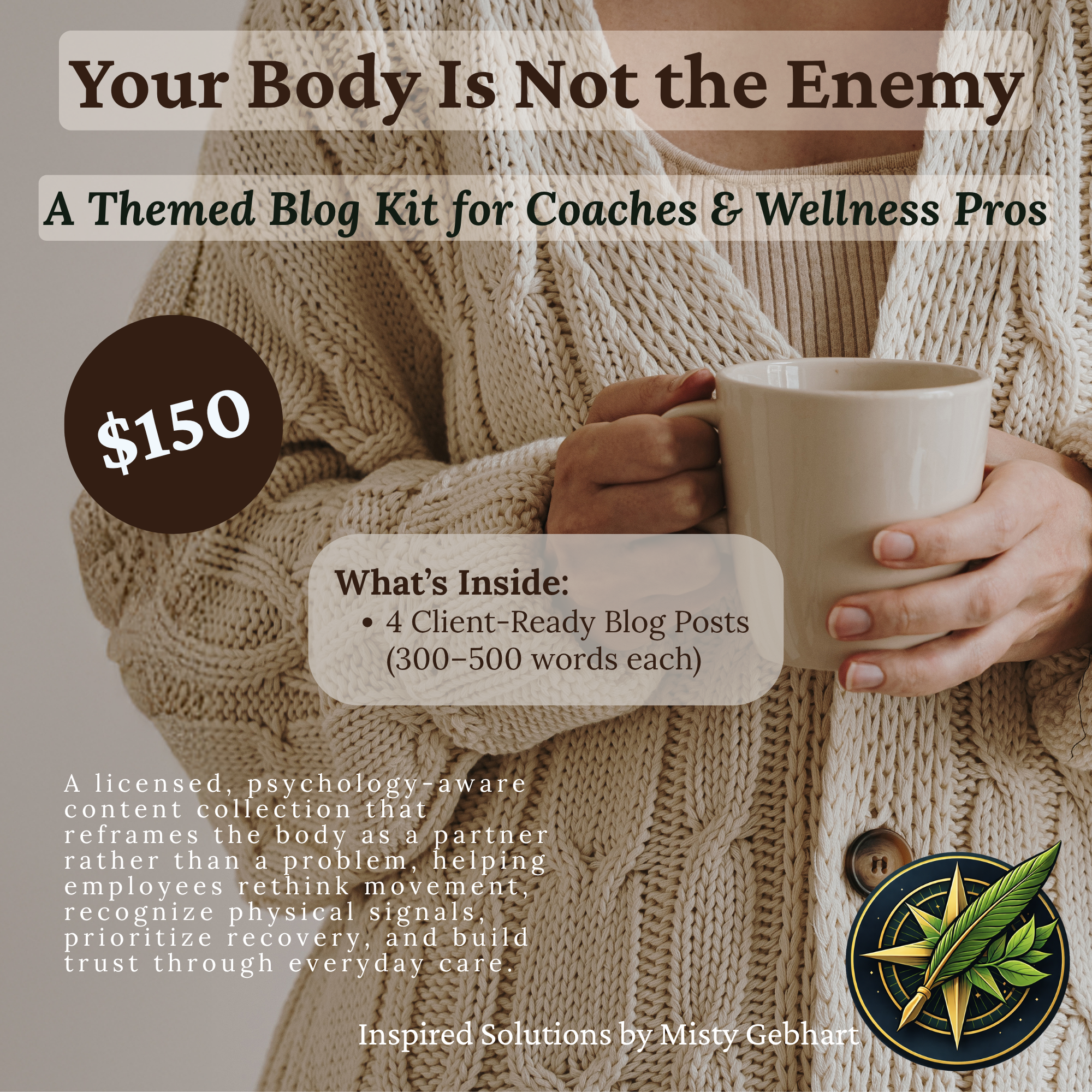
Your Body Is Not the Enemy - Themed Blog Set
Give your audience wellness content that doesn't begin by telling them their body needs to be fixed.
Move more.
Push through.
Be disciplined.
Ignore the discomfort.
Rest when the work is finished.
Modern wellness messaging can make the body sound like a stubborn obstacle standing between us and the healthier, more productive version of ourselves we're supposed to become.
Your Body Is Not the Enemy offers a very different conversation.
This four-part licensed blog series helps readers reconsider their relationship with movement, physical signals, and recovery — replacing pressure and performance with curiosity, responsiveness, and partnership.
Because the body isn't simply something to manage.
It's the place from which we experience our entire lives.
Four ready-to-publish wellness articles — already written.
Your Body Is Not the Enemy is a licensed collection of four coordinated wellness articles for businesses and organizations that want deeper educational content around movement, body awareness, recovery, and sustainable physical wellbeing without relying on weight-loss messaging, fitness challenges, or guilt.
Rather than teaching readers to override themselves more effectively, the series develops one larger idea:
The body is constantly providing information. A more sustainable relationship begins when we learn to listen and respond instead of automatically pushing past it.
You publish the articles through your own channels, within your own branded environment, while retaining the original written content and required author attribution.
What's inside
4 coordinated, full-length wellness blog posts
One cohesive wellness theme
Ready-to-publish written content
Ongoing licensed use with your own audience
Freedom to format the articles within your own brand environment
Permission to add your own clearly separate business CTA before or after each article
$150 — one-time license fee
No subscription. No recurring charges.
One payment gives your business or organization licensed use of the complete four-part educational series with your own audience.
Publish the articles on your website or blog, include them in newsletters or email communications, share them through employee wellness communications or internal resource libraries, or provide them as educational content to your clients, patients, customers, or members.
The blog series
Movement Counts More Than You Think
Challenges the narrow definition of movement that leaves many people believing physical activity only matters when it looks like formal exercise.
Workout clothes. A gym. A structured routine. A specific number of minutes, steps, or calories.
But the body doesn't categorize movement that way.
Walking through a museum, tending a garden, carrying groceries, climbing stairs, playing with a child, dancing while dinner cooks, or wandering through a bookstore all require the body to participate.
This article expands the definition of movement and gives readers a more useful question than Did I exercise today?
How did I move my body today?
That distinction can be especially meaningful for people who have spent years believing they're simply "bad at exercise." They may discover that movement is already part of their lives — and that caring for the body doesn't have to revolve around forcing themselves into someone else's definition of fitness.
Let Movement Feel Good
Brings something back into the wellness conversation that adulthood has a remarkable ability to remove:
enjoyment.
Movement can gradually become another obligation — something scheduled, measured, and completed because we're supposed to do it.
But it wasn't always that way.
As children, we ran, climbed, danced, explored, and played because moving was part of experiencing life.
This article invites readers to rediscover forms of movement they genuinely enjoy and pay attention to activities that leave them energized rather than relieved that they're over.
Joyful movement doesn't need to resemble a traditional workout. Gardening, swimming, walking the dog, exploring a farmer's market, playing with grandchildren, or dancing around the kitchen all count.
And enjoyment isn't evidence that someone is somehow cheating at wellness.
It can be useful information about what they're actually likely to sustain.
Perhaps the goal isn't convincing yourself to exercise more. Perhaps it's rediscovering the kinds of movement that make you feel more alive.
Your Body Is Giving You Feedback
Examines something many of us were never really taught to do:
notice what the body is communicating.
Fatigue. Hunger. Tension. Stiffness. Soreness. Pain. Energy. The need for movement. The need for rest.
Modern life makes those signals remarkably easy to override. Work, caregiving, appointments, errands, and responsibilities keep moving whether the body is asking for attention or not.
This article helps readers distinguish between supporting the body and pushing it.
Rather than encouraging constant self-monitoring, it offers a much simpler practice: occasionally pause long enough to ask, How does my body actually feel right now?
Sometimes the answer will be movement.
Sometimes hydration, nourishment, stretching, or a slower pace.
Sometimes rest.
Rebuilding body trust doesn't require a dramatic wellness overhaul. It can begin with one quiet check-in and one honest question:
What do I need right now?
Recovery Is Part of Progress
Addresses the mental discomfort that can make rest surprisingly difficult.
Many people are willing to work hard. They're willing to stay committed, push toward goals, and keep going when things are demanding.
Stopping can be harder.
Rest can trigger questions about whether enough has been accomplished, whether one more thing could fit into the day, or whether slowing down means becoming lazy.
This article reframes recovery as part of the process rather than the absence of it.
Physical adaptation happens through cycles of effort and recovery. Mental focus, emotional resilience, creativity, and everyday energy also benefit from opportunities to pause and restore.
Instead of waiting until depletion makes rest unavoidable, readers are encouraged to consider smaller recovery windows before the body reaches its limit.
Because sustainable wellness isn't built by discovering how much a person can endure.
It's built by creating enough space to begin again tomorrow.
Why this series works
A great deal of wellness content is built around correction.
Change your body. Improve your body. Discipline your body. Push your body. Measure your body.
Your Body Is Not the Enemy changes the relationship before trying to change the behavior.
It helps your audience:
Expand their definition of meaningful movement beyond formal exercise
Use enjoyment as information when finding movement they can realistically sustain
Recognize fatigue, hunger, tension, soreness, and other physical signals as useful feedback
Understand recovery as part of sustainable progress rather than something that must be earned
The result is body-aware wellness education without weight-loss messaging, before-and-after narratives, punishment-based fitness, or the assumption that care has to begin with dissatisfaction.
Make it look at home in your brand — without rewriting the work.
The articles remain the authored work of Misty Gebhart | Inspired Chapter, but they can live naturally inside your existing communication channels.
Publish them using your own fonts, colors, layout, logo, headers, footers, and appropriate imagery. Add your own business information or CTA before or after the article as permitted by the included Themed Blog Set license.
The written articles themselves remain as provided, and the Inspired Chapter author attribution stays with each piece.
Use it throughout your content ecosystem
Publish one article each week to create a coordinated month-long conversation about movement, body awareness, recovery, and trust.
Use an individual article when its subject fits what your audience needs. Include one in a newsletter. Add the series to an employee resource library. Share it with clients, patients, customers, or members alongside the services you already provide.
Each article stands on its own.
Together, they build a larger message:
Your body isn't something you have to defeat in order to care for it.
Want the complete campaign instead?
If you want to take Your Body Is Not the Enemy beyond the four-blog series, the $249 Month-in-a-Box expands the same theme into a complete monthly wellness content system.
The full Month-in-a-Box includes the four supporting blogs plus:
The long-form anchor article "Your Body Is Not the Enemy: Rebuilding Trust Through Movement, Recovery, and Everyday Care", exploring the shift from overriding the body to working with it through movement, enjoyment, feedback, recovery, and repeated acts of responsiveness
A 28-day content planner moving through A Different Relationship, Movement With Care, Listening to the Signals, and Trust Through Recovery
Light assets including five quotes, two caption-ready posts, closing lines, visual direction, and six writing hooks
The employee- and client-facing "Finding Movement That Feels Supportive" guide, which helps users identify movement that has felt natural, notice which activities leave them supported rather than depleted, and design a realistic movement practice that fits their own lives
Choose the Themed Blog Set when you primarily need substantive educational articles for your existing content channels.
Choose the Month-in-a-Box when you want the larger body-partnership conversation developed into a coordinated month-long content system.
Who this is for
Wellness businesses looking for body-aware content without weight-loss or punishment-based messaging
HR and People Operations teams that want a more inclusive approach to physical wellbeing
Healthcare and wellness professionals who want practical education around movement, recovery, and body awareness
Internal Communications teams looking for approachable physical-wellness content that doesn't prescribe a particular fitness routine
Organizations that want to encourage sustainable care without making employees' bodies another performance project
Who this is not for
Organizations looking for clinical, therapeutic, medical, or individualized fitness content
Businesses looking for private-label or ghostwritten content they can claim as their own
Teams that need to rewrite or substantially customize the articles
Anyone looking to resell, sublicense, transfer, or redistribute the content to another organization
A quick note about licensing
Your purchase licenses these four articles for publication to your own audience by one business, organization, or brand.
Copyright and authorship remain with Misty Gebhart / Inspired Chapter. The written content stays as provided, and the required Inspired Chapter author attribution remains with each published article.
The license does not include editing rights, white-label rights, resale rights, or the right to transfer the articles to another business or organization.
All content is the intellectual property of Inspired Chapter / Misty Gebhart and is provided under license. © 2026 Inspired Chapter. All Rights Reserved. Licensed, not sold.
Give your audience wellness content that doesn't begin by telling them their body needs to be fixed.
Move more.
Push through.
Be disciplined.
Ignore the discomfort.
Rest when the work is finished.
Modern wellness messaging can make the body sound like a stubborn obstacle standing between us and the healthier, more productive version of ourselves we're supposed to become.
Your Body Is Not the Enemy offers a very different conversation.
This four-part licensed blog series helps readers reconsider their relationship with movement, physical signals, and recovery — replacing pressure and performance with curiosity, responsiveness, and partnership.
Because the body isn't simply something to manage.
It's the place from which we experience our entire lives.
Four ready-to-publish wellness articles — already written.
Your Body Is Not the Enemy is a licensed collection of four coordinated wellness articles for businesses and organizations that want deeper educational content around movement, body awareness, recovery, and sustainable physical wellbeing without relying on weight-loss messaging, fitness challenges, or guilt.
Rather than teaching readers to override themselves more effectively, the series develops one larger idea:
The body is constantly providing information. A more sustainable relationship begins when we learn to listen and respond instead of automatically pushing past it.
You publish the articles through your own channels, within your own branded environment, while retaining the original written content and required author attribution.
What's inside
4 coordinated, full-length wellness blog posts
One cohesive wellness theme
Ready-to-publish written content
Ongoing licensed use with your own audience
Freedom to format the articles within your own brand environment
Permission to add your own clearly separate business CTA before or after each article
$150 — one-time license fee
No subscription. No recurring charges.
One payment gives your business or organization licensed use of the complete four-part educational series with your own audience.
Publish the articles on your website or blog, include them in newsletters or email communications, share them through employee wellness communications or internal resource libraries, or provide them as educational content to your clients, patients, customers, or members.
The blog series
Movement Counts More Than You Think
Challenges the narrow definition of movement that leaves many people believing physical activity only matters when it looks like formal exercise.
Workout clothes. A gym. A structured routine. A specific number of minutes, steps, or calories.
But the body doesn't categorize movement that way.
Walking through a museum, tending a garden, carrying groceries, climbing stairs, playing with a child, dancing while dinner cooks, or wandering through a bookstore all require the body to participate.
This article expands the definition of movement and gives readers a more useful question than Did I exercise today?
How did I move my body today?
That distinction can be especially meaningful for people who have spent years believing they're simply "bad at exercise." They may discover that movement is already part of their lives — and that caring for the body doesn't have to revolve around forcing themselves into someone else's definition of fitness.
Let Movement Feel Good
Brings something back into the wellness conversation that adulthood has a remarkable ability to remove:
enjoyment.
Movement can gradually become another obligation — something scheduled, measured, and completed because we're supposed to do it.
But it wasn't always that way.
As children, we ran, climbed, danced, explored, and played because moving was part of experiencing life.
This article invites readers to rediscover forms of movement they genuinely enjoy and pay attention to activities that leave them energized rather than relieved that they're over.
Joyful movement doesn't need to resemble a traditional workout. Gardening, swimming, walking the dog, exploring a farmer's market, playing with grandchildren, or dancing around the kitchen all count.
And enjoyment isn't evidence that someone is somehow cheating at wellness.
It can be useful information about what they're actually likely to sustain.
Perhaps the goal isn't convincing yourself to exercise more. Perhaps it's rediscovering the kinds of movement that make you feel more alive.
Your Body Is Giving You Feedback
Examines something many of us were never really taught to do:
notice what the body is communicating.
Fatigue. Hunger. Tension. Stiffness. Soreness. Pain. Energy. The need for movement. The need for rest.
Modern life makes those signals remarkably easy to override. Work, caregiving, appointments, errands, and responsibilities keep moving whether the body is asking for attention or not.
This article helps readers distinguish between supporting the body and pushing it.
Rather than encouraging constant self-monitoring, it offers a much simpler practice: occasionally pause long enough to ask, How does my body actually feel right now?
Sometimes the answer will be movement.
Sometimes hydration, nourishment, stretching, or a slower pace.
Sometimes rest.
Rebuilding body trust doesn't require a dramatic wellness overhaul. It can begin with one quiet check-in and one honest question:
What do I need right now?
Recovery Is Part of Progress
Addresses the mental discomfort that can make rest surprisingly difficult.
Many people are willing to work hard. They're willing to stay committed, push toward goals, and keep going when things are demanding.
Stopping can be harder.
Rest can trigger questions about whether enough has been accomplished, whether one more thing could fit into the day, or whether slowing down means becoming lazy.
This article reframes recovery as part of the process rather than the absence of it.
Physical adaptation happens through cycles of effort and recovery. Mental focus, emotional resilience, creativity, and everyday energy also benefit from opportunities to pause and restore.
Instead of waiting until depletion makes rest unavoidable, readers are encouraged to consider smaller recovery windows before the body reaches its limit.
Because sustainable wellness isn't built by discovering how much a person can endure.
It's built by creating enough space to begin again tomorrow.
Why this series works
A great deal of wellness content is built around correction.
Change your body. Improve your body. Discipline your body. Push your body. Measure your body.
Your Body Is Not the Enemy changes the relationship before trying to change the behavior.
It helps your audience:
Expand their definition of meaningful movement beyond formal exercise
Use enjoyment as information when finding movement they can realistically sustain
Recognize fatigue, hunger, tension, soreness, and other physical signals as useful feedback
Understand recovery as part of sustainable progress rather than something that must be earned
The result is body-aware wellness education without weight-loss messaging, before-and-after narratives, punishment-based fitness, or the assumption that care has to begin with dissatisfaction.
Make it look at home in your brand — without rewriting the work.
The articles remain the authored work of Misty Gebhart | Inspired Chapter, but they can live naturally inside your existing communication channels.
Publish them using your own fonts, colors, layout, logo, headers, footers, and appropriate imagery. Add your own business information or CTA before or after the article as permitted by the included Themed Blog Set license.
The written articles themselves remain as provided, and the Inspired Chapter author attribution stays with each piece.
Use it throughout your content ecosystem
Publish one article each week to create a coordinated month-long conversation about movement, body awareness, recovery, and trust.
Use an individual article when its subject fits what your audience needs. Include one in a newsletter. Add the series to an employee resource library. Share it with clients, patients, customers, or members alongside the services you already provide.
Each article stands on its own.
Together, they build a larger message:
Your body isn't something you have to defeat in order to care for it.
Want the complete campaign instead?
If you want to take Your Body Is Not the Enemy beyond the four-blog series, the $249 Month-in-a-Box expands the same theme into a complete monthly wellness content system.
The full Month-in-a-Box includes the four supporting blogs plus:
The long-form anchor article "Your Body Is Not the Enemy: Rebuilding Trust Through Movement, Recovery, and Everyday Care", exploring the shift from overriding the body to working with it through movement, enjoyment, feedback, recovery, and repeated acts of responsiveness
A 28-day content planner moving through A Different Relationship, Movement With Care, Listening to the Signals, and Trust Through Recovery
Light assets including five quotes, two caption-ready posts, closing lines, visual direction, and six writing hooks
The employee- and client-facing "Finding Movement That Feels Supportive" guide, which helps users identify movement that has felt natural, notice which activities leave them supported rather than depleted, and design a realistic movement practice that fits their own lives
Choose the Themed Blog Set when you primarily need substantive educational articles for your existing content channels.
Choose the Month-in-a-Box when you want the larger body-partnership conversation developed into a coordinated month-long content system.
Who this is for
Wellness businesses looking for body-aware content without weight-loss or punishment-based messaging
HR and People Operations teams that want a more inclusive approach to physical wellbeing
Healthcare and wellness professionals who want practical education around movement, recovery, and body awareness
Internal Communications teams looking for approachable physical-wellness content that doesn't prescribe a particular fitness routine
Organizations that want to encourage sustainable care without making employees' bodies another performance project
Who this is not for
Organizations looking for clinical, therapeutic, medical, or individualized fitness content
Businesses looking for private-label or ghostwritten content they can claim as their own
Teams that need to rewrite or substantially customize the articles
Anyone looking to resell, sublicense, transfer, or redistribute the content to another organization
A quick note about licensing
Your purchase licenses these four articles for publication to your own audience by one business, organization, or brand.
Copyright and authorship remain with Misty Gebhart / Inspired Chapter. The written content stays as provided, and the required Inspired Chapter author attribution remains with each published article.
The license does not include editing rights, white-label rights, resale rights, or the right to transfer the articles to another business or organization.
All content is the intellectual property of Inspired Chapter / Misty Gebhart and is provided under license. © 2026 Inspired Chapter. All Rights Reserved. Licensed, not sold.